The House Select Committee on Assassinations' investigation into Lee Harvey Oswald's activities in Mexico City has been directed at answering the following questions:
The approach taken by this Committee's investigation differs from that of the Warren Commission primarily in terms of scope. The Warren Commission and the investigative agencies at its disposal went to great lengths to establish Oswald's travel to and from Mexico, but devoted minimal effort to evaluating Oswald's contacts with the Cuban and Soviet Consulates. It is the conclusion of this Committee that the Warren Commission correctly established that Oswald had traveled to Mexico City. Hence, this Committee has chosen not to reinvestigate Oswald's travel to and from Mexico City. Instead, the Committee's approach has been to focus narrowly on Oswald's contacts with the Soviet and Cuban diplomatic missions in Mexico City and on evidence that was not available to the WarrenCommission that could possibly shed light on Oswald's activities in Mexico City outside of the Soviet and Cuban installations.
The Warren Report limited its discussion of Oswald's contacts with the Soviet and Cuban diplomatic missions to information obtained from Sylvia Duran and the Cuban Government.([1])
At one point in the Report the Commissions referred to other information:
In an attempt to answer the questions posed by Lee Harvey Oswald's visit to Mexico City in September and October of 1963, the House Select Committee on Assassinations has pursued the following investigative procedure:
The following report detailing the results of this Committee's investigative efforts regarding Mexico City is divided into general areas:
The reader should be advised at the outset that the first section following is technical in nature and may not appear directly relevant at first blush. But the report is cumulative in nature. The specific, detailed analyses of the standard operating procedures in the first section are necessary to, and form a partial basis for, the reconstruction of the Mexico City Station's handling of the Oswald case. There are many gaps left by the documentary and testimonial evidence concerning the manner in which the CIA's Mexico City Station and Headquarters reacted to Oswald's presence in Mexico City. A knowledge of the ways in which the Mexico City Station operated and the procedures involved in those surveillance operations which detected Oswald is valuable in filling the gaps of the specific case which is the subject of this report.
The Mexico City Station of the Central Intelligence Agency maintained photographic surveillance on the Cuban diplomatic compound during September and October of l963.([3]) The purpose of this operation was to get identifiable photographs of all individuals who visited the Cuban diplomatic compound.([4])
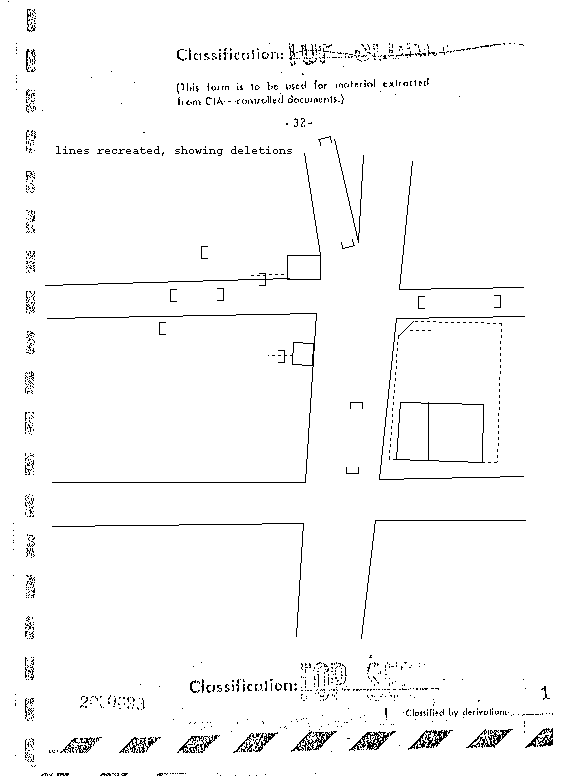
The Cuban diplomatic compound covered one city block in Mexico City between Tacubaya, Francisco Marquez and Zamora Streets. The entrance to the Cuban Embassy was located on the corner of Tacubaya and Francisco Marques.([5]) Next to this entrance on Francisco Marquez Street was another entrance for automobiles.([6]) The entrance to the Cuban Consulate, which was in a separate building from the Embassy, as located on the corner of Francisco Marquez and Zamora.([7]) The CIA surveillance post was located at [ ] ([8]) An agent photographed visitors to the Embassy from one window in the third floor apartment at [ ] ([9]) A pulse camera covered the entrance to the Consulate from a second window in the same third floor apartment.([10])
One CIA officer, who claimed to have had a marginal role in this surveillance operation, remembers that they had trouble covering both the Cuban Embassy entrance and the Consulate entrance.([11]) "The Cuban Embassy coverage had more sophisticated equipment using a pulse camera which frequently developed mechanical difficulties."([12]) Two former CIA employees who were in Mexico City in l963 remembered that there. were two cameras covering the Cuban diplomatic compound.([13]) Ms. Goodpasture, a case officer in the Mexico City Station, testified that she could not remember the locations of the two cameras.([14]) David A. Phillips, Chief of the Cuban Section in the Mexico City Station, testified that the Consulate entrance was covered along with the Embassy entrance.([15]) Mr. Phillips was not absolutely sure of his recollection, but thought that it was possible that the Embassy entrance had been covered by a manned photographic base and the Consulate entrance was covered by a pulse camera.([16])
The CIA staff technician who serviced the cameras and trained the agents at the CIA photographic base that covered the Cuban compound was interviewed by the House Select Committee on Assassinations. The technician stated that he had set up the cameras in the photographic base at the inception of an operation in the early 1960's designed to provide photographic surveillance of the Cuban compound. For a short time after the inception of the operation, the technician had been responsible for maintaining liaison between the agents inside the base and the Station. After the agent's training was completed, the technician turned the liaison responsibilities over to a case officer.([17]) He could not remember with certainty the identity of that case officer, but thought that it may have been [ ] ([18]) The technician remembered that the operation had originally covered the Cuban Embassy entrance with a manually operated Exacta or Leica camera. He said that this camera had been set up on a tripod and was equipped with a Bal-Scope.([19]) Later, according to the technician, a pulse camera was installed in this base [written ibid. p 3] The pulse camera was set up to cover the Consulate entrance, while the agents continued covering the Embassy entrance with the manual camera.[written ibid.] The technician could not remember with certainty when the pulse camera was installed in the base. The technician told the House Select Committee on Assassinations that the exact time of installation could be checked by reviewing the project files maintained at CIA Headquarters.([20])
The technician remembered quite a few details about how the pulse camera had been set up and how it worked. He remembered that the shutter was triggered by a device attached to a spotting scope.([21]) The triggering device was activated by changes in light intensity The spotting scope was trained on a very narrow area of the door latch of the Cuban Consulate entrance. The camera itself covered a much broader field than the spotting scope. The camera was set up so-as to make sure that a person triggering the camera by passing between the spotting scope and its target, the door latch, would be photographed from the waist up.([22])
The technician stated that the agent in the photographic basehouse serviced his own cameras, and developed the film and made contact prints in the basehouse.([23]) The agent covering the Embassy entrance kept a log corresponding to the photographs taken.([24])
The project files for this operation bear out the technician's recollections. An examination of these files by the House Select Committee on Assassinations revealed several of the technician's monthly reports. An examination of the chronological file of dispatches passing between CIA Headquarters and the Mexico City Station turned up one additional monthly report that was not located in the project file. A third relevant dispatch was made available to the Committee on 20 November 1978. The report in the dispatch chronology covers the period of 1 September to 30 September 1963.([25]) The dispatch reports that on 23 September 1963 the agent who ran the Cuban photographic basehouse called the technician into the basehouse to discuss the layout of the Cuban Consulate.([26]) The entrance to the Cuban Consulate had been closed in 1961 due to harassment and stink bombings.([27]) A few days prior to the 23rd, the Consulate had once again opened its door to the public. Prior to this reopening of the Consulate door, the photography agent had limited his coverage to the main Embassy gate.([28]) He used an Exacta camera with a Bal-Scope with a 30-power eyepiece. The dispatch reported, however, from the position he had to cover the main gate, he could not cover the newly reopened Consulate entrance.([29]) The base agent told the technician that at that time, approximately seventy percent of all the visitors to the Cuban compound were using the Embassy entrance and the remainder used the Consulate entrance.([30])
The technician discussed this problem with the case officer for the project [ ] ([31]) [ ] asked the technician to add additional photographic coverage to the basehouse so as to cover the Consulate door.([32]) On 26 September the technician tested equipment for use in the basehouse.([33]) The dispatch goes on to say:
The photography agent was instructed to test each camera for four days. The report says that the results of these test days will be forwarded to the Technical Services Division at Headquarters as soon as they become available.([35])
On 7 November 1963 the Mexico City Station filed a report on the functioning of the pulse camera.([36]) This dispatch is referenced to HMMA-22307, paragraph 5, c.([37]) It says that the VLS-2 triggering device had been performing well with little false triggering. The 500 mm lens was replaced with a 6-inch lens so as to obtain wider coverage of the Consulate door.([38]) During the first two weeks that the pulse camera was in operation, the VLS-2 triggered the camera anytime that anyone entered or left the Consulate door. This dual photography used an excessive amount of film, so the base agent adjusted the VLS-2 so that it only photographed people leaving the Cuban compound by the Consulate door.([39]) The base agent used "the K-100 camera with a 152 mm lens for one day turning in 10 fee (sic) of 16 mm film."([40]) Samples of the photos taken "on that day" with the camera are enclosed with the dispatch.([41]) The Robot Star camera that was placed in the base on September 27 broke down after four days of operation and was replaced with a second Robot Star camera.([42]) This Robot Star broke down after five days of operation. At the time of this dispatch in November, a Robot Star camera was in operation.([43]) Samples of this camera's photographs were also sent with this dispatch.([44]) Hence, between September 27, 1963 and November 7, 1963, at least three, and possibly four, cameras were used in the photo base with the VLS-2 automatic triggering device. On the 27th, the photo-technician installed two cameras, K-100 and the first Robot Star, with the VLS-2 triggering device.([45]) The K-100 was used for one day.([46]) The first Robot Star worked for four days; a second Robot Star worked for five days.([47]) On 11/7/63 a Robot Star was in operation at the base.([48]) It is not clear whether the Robot Star which was working at the time of the November dispatch was a third camera or one of the earlier ones which could have been repaired. In any event, the Station asked that a new camera be sent to replace the Robot Star.([49])
On June 1964 the CIA Mexico City Station sent a cable to Headquarters alerting them that they were sending up the negatives from the pulse camera coverage of the Cuban Embassy.([50]) All available negatives and five packages of undeveloped film were sent to Headquarters by transmittal manifest #252572.([51])
The cable apologizes for the delay in sending the negatives caused by "consolidation and dating."([52]) The cable suggests that Headquarters retain possession of the negatives and informs Headquarters that the negatives will be forwarded to them on a regular basis.([53])
A transmittal manifest is "unaccountable."([54]) That means that the document and the material it transmits is not made part of the record and is, therefore, unretrievable.([55])
The CIA made the photo-technician's monthly report for December available to the Committee on 16 November 1978.([56]) On the morning of 17 December 1963, a 35 mm Sequence camera was installed in the base house and the VLS-2 trigger device.([57]) The installation of this Sequence camera was probably in response to the request for a replacement camera in HMMA-22433.
On 22 June 1965 the CIA Mexico City Station sent a dispatch to Headquarters to familiarize them with the details of the pulse camera operation.([58])
The dispatch goes on to report that a technician from Headquarters brought a pulse camera to Mexico City mid-December 1963, installed and tested it, and instructed the technician resident in Mexico City and the base agent in the use and maintenance of the camera.([60])
On the basis of HMMA-22307, HMMA-22433 and MEXI 9940, the Committee believes that it is probable that the pulse camera was in operation on the days that Lee Harvey Oswald visited the Cuban Consulate. This Committee requested the photographs produced by the pulse camera by the project's cryptonym on 22 June 1978. The CIA informed a House Select Committee on Assassinations researcher on 7/20/78 that the cryptonym did not refer to a photographic project.([61]) A more specific request for the photographs was made on 21 July 1978.([62])
On 13 October 1978 the Committee, as a result of a review of materials taken by James Angleton from Win Scott's safe at the time of his death,([63]) addressed another letter to the CIA on this matter.([64]) This letter said, in part:
The CIA responded to this letter on 25 October 1978.([66]) The CIA informed the Committee that it was their belief that the pulse camera was not in operation during September of 1963.([67])
HMMA-22307 definitely reports the installation of the two cameras and a VLS-2 trigger device on 27 September 1963.([69]) But the cameras did not function smoothly.([70]) HMMA-22433 reported that the K-100 camera broke down after one day's operation.([71]) It was replaced with the first Robot Star. which had also been installed on September 27. The first Robot Star broke down four days after its installation.([72]) A second Robot Star broke down after five days of operation.([73]) A Robot Star was working on 7 November 1963, when HMMA-22433 requested that Headquarters send a replacement camera to Mexico.([74]) In all likelihood, that request was filled with the installation of the Sequence camera on 17 December 1963 detailed in HMMA-22726.([75]) Under this interpretation of the documents, the operation would have gone into continuous operation in mid-December 1963 as claimed by the CIA. But the first pulse camera was set up on Friday September 27, 1963. The documents do not specify the days that the original cameras functioned. HMMA-22307 says:
This Committee believes that it is reasonable to assume that the base agent started using the equipment immediately after it was installed.([78]) Hence, the one day that the K-100 was used would have been either the 27th (the day it was installed), the 28th (a Saturday) or the 30th (the following Monday). It is also reasonable to assume that the Robot Star was put into action the day of, or the day following, the breakdown of the K-100. This camera worked for four
[PAGE 27 MISSING}
Phillips.([84]) During September, October and November of 1963, the Cuban Consulate was open to the public from 10:00 a.m. to 2:00 p.m.; the Embassy was open to the public from 9:00 a.m. to 5:00 p.m.([85])
A blind memo, dated 11/27/64, entitled "Memo passed to Mr. Papich of FBI with info on photo coverage of Embassies and info on Kostikov," implies that the coverage on the Cuban Embassy was of a continuous nature during daylight hours. This memo also implies that there was a coverage of the Cuban Consulate.([86]) The technician who serviced this operation in Mexico City remembers that he tried to get full daylight coverage of the compound but that it was very difficult.([87]) He said that the manual coverage was usually good but that human error had to be taken into account when considering the manual coverage. He pointed out that it was hard for a person to maintain constant attention in such a sedentary job and, hence, some visitors would get by the manual operation.([88]) The technician also remembered that he had set up the pulse camera to provide constant daylight coverage.([89]) By 1965 the pulse camera was only working for six hours a day.([90]) The House Select Committee on Assassinations has not been able to determine the scope of the pulse camera coverage during September and October 1963 by examination of the production because that production, if it exists, has not been made available for review.([91])
The CIA has made the photographic production and logs from the manual coverage of the Embassy entrance available for House Select Committee on Assassinations review.([92]) All production from the manual camera coverage of the Cuban Embassy for months of September, October and November was examined.([93]) [94]This examination revealed that the coverage. of the Embassy was fairly consistent between the hours of 9:00 a.m. and 2:00 p.m. on weekdays.([95]) There was coverage, with a few exceptions, on every weekday.([96]) There was no coverage on weekends.([97]) During the three-month period examined by the House Select Committee on Assassinations only four weekdays were not covered by the photographic surveillance operation aimed at the Cuban Embassy.([98]) There was no evidence in the files of serious technical difficulties or camera problems in the manual operation during these three months.([99])
The photographs from the manual camera were maintained in a chronological file at the CIA station in Mexico City.([100]) The photographs were routinely shown to [ ] for identification purposes.([101]) After this agent left [ t. ] in 1965, the photographs were sent to the JM/WAVE Station in Miami, Florida for review by Cuban defectors such as AMMUG/1.([102])
The disposition of the pulse camera photographs in general, beyond the fact that as of 1965, and possibly earlier, the production was routinely sent to Headquarters, is unknown.([103]) The CIA denies that the pulse camera was functioning during the time Oswald was in Mexico.([104]) If the Committee's belief that the pulse camera was functioning on the days that Oswald visited the Cuban Consulate is correct, then the ultimate disposition of the photographs produced on those days remains a mystery.
The Mexico City CIA Station maintained photographic surveillance on the Soviet diplomatic compound in Mexico City in 1963. Three photographic sites, or bases, were used in this operation.([105]) The primary objective of the operation was to photograph people who visited the Soviet Embassy.([106]) The operation, generally, covered the main gate of the Soviet compound between 900 and 1800 (or dark) on weekdays and from 900 to 1400 on Saturdays.([107])
There were three bases which provided photographic surveillance of the Soviet diplomatic compound in 1963.([109]) One of the bases [
] ([110]) The other two bases, of primary concern to this Committee,[
] ([111]) The primary base,[ ] was [
] the secondary, or "back-up," [ ] base [
] ([112])
The purpose of this operation has also been described as being to obtain photographs of Soviet officials and their families; all foreigners (non-Latins) who visited the Embassy; and cars with foreign license plates.([113]) One of the main purposes of the photographic bases that covered the Embassy gate was to obtain a photograph of every "foreigner," or non-Latin, in contact with the Soviet Embassy.([114])
This was done in an attempt to identify possible Soviet espionage agents.
It is reported that the Mexican nationals who manned the photographic bases and actually took the photographs had an "uncanny ability" to pick out foreigners.([116])
The House Select Committee on Assassinations next attempted to determine the scope of the photographic coverage on the main gate of the Soviet Embassy. At a minimum, the Embassy was probably covered by the photographic operations during office hours. "The instructions were to cover the entire work day (office hours)..."([117]) "Instructions were to cover office hours, photograph each new Soviet and family, all foreigners and foreign license plates."([118]) The normal work hours of the Soviet Embassy during September and October of 1963 were from 9:00 a.m. to 6:00 p.m.([119])
There are some indications that the photographic coverage was more extensive than just office hours. Even though the Embassy was not open past 6:00 p.m., visitors could still gain entrance by ringing the gate bell. "Russian speakers can get in any time."([120]) Hand written "two"[Hand written two] One CIA officer who was in Mexico City remembers "that the photo surveillance was constant except for instances where it would be down for security reasons or equipment malfunction."([121]) A blind memorandum, dated 11/27/63, entitled "Memo passed to Mr. Papich of FBI with info on photo coverage of embassies and info on Kostikov," says, in part,
The House Select Committee on Assassinations reviewed production and log materials from one base [ ], which covered the gate of the Soviet diplomatic compound.([127]) The [ ],base was referred to as the "primary" base because it began operation before the [ ] base opened.([128])
[ ] was planned as an alternate base to [
]. It had a slanted view of the front gate of the Soviet Embassy.([129])
The following chart lists the production from the [ ] base which was made available to the House Select Committee on Assassinations.([130])
Date          Hours of cover-     Time of 1st          Time of
last     Number of Photo-
          age stated          photgraph          photograph          graphs
taken

Aug.     31     800-1400          956               1220               8
(Saturday)
Sept.      1     800-2000          1009               1321               6
(Sunday)
     2     830-1900          935               1556               19
     3     830-1800          1131               1334               18
     4     830-1800          1001               1715               43
     5     1200-1900          1238               1510               12
     6     830-1800          926               1702               39
     7     ***************NO COVERAGE******************************
     8     ***************NO COVERAGE******************************
     9     900-1900          1159               1640               3
     10     830-1800          855               1119               17
     11     900-1900          1132               1550               14
     12     900-1900          1015               1233               7
     13     ***************NO COVERAGE******************************
     14     1000-1400          1047               1344               10
(Saturday)
     15     ***************NO COVERAGE******************************
     16     ***************NO COVERAGE******************************
     17     900-1900          1133               1549               19
     18     ***************NO COVERAGE******************************
     19     900-1900          1105               1654               13
     20     ***************NO COVERAGE******************************
     21     ***************NO COVERAGE******************************
     22     ***************NO COVERAGE******************************
     23     900-1900          1137               1300               7
     24     ***************NO COVERAGE******************************
     25     900-1900          1040               1137               6
     26     ***************NO COVERAGE******************************
     27     900-1900          1018               1146               16
          28     ***************NO
COVERAGE******************************
     29     ***************NO COVERAGE******************************
     30     ***************NO COVERAGE******************************
Oct.     1     900-1900          1251               1251               2
     2     900-1900          1139               1259               14
     3     900-1900          1200               1222               5
     4     900-1900          1103               1251               21
     5     ***************NO COVERAGE******************************
     6     ***************NO COVERAGE******************************
     7     900-1900          1158               1235               6
     8     900-1900          1219               1232               5
     9     900-1900          1108               1210               4
     10     900-1900          1031               1719               18
     11     900-1900          1522               1733               9
     12     1000-1400          1002               1015               2
(Saturday)
     13     ***************NO COVERAGE******************************
     14     800-1900          831               944               12
     15     ***************NO COVERAGE******************************
     16     ***************NO COVERAGE******************************
     17     900-1900          1624               1649               7
     18     1200-1900          1404               1437               2
     19     ***************NO COVERAGE******************************
     20     ***************NO COVERAGE******************************
     21     ***************NO COVERAGE******************************
     22     1200-1900          1305               1307               3

     23     1200-1900          N.A.+               N.A.               8
     24     1200-1900          N.A.               N.A.               22
     25     1200-1900          N.A.               N.A.               21
     26     1000-1600          N.A.               N.A.               14
(Saturday)

          +Not Available
Given the somewhat uneven nature of the coverage by [ ] (131) the House Select Committee on Assassinations asked whether the two bases were run in conjunction so as to provide more comprehensive coverage. [ ] the project's case officer, did not remember that this was the case. He did remember that both bases operated at the same time so as to get the most complete coverage possible.([132]) [ ] was not sure whether there was routine coverage of the Soviet Embassy on weekends.([133]) He said that it was possible that there was routine coverage on Saturday mornings.([134])
An examination of the project file maintained by the CIA on the photographic coverage of the Soviet Embassy does not bear out [ ] assertion that the two bases duplicated efforts. In fact, the project file confirmed that the bases complemented each other rather than duplicated efforts. This was the case in l960 when a project review stated:
Similar statements are included in the project reviews for [ ] ([137]) At one point a move was made at Headquarters to close the [ ] base:
The Mexico City Station took exception to this recommendation:
In l964 the Mexico City Station restated the operating procedures of the two bases in a dispatch referenced to the above paragraph from HMMA-l4793:
[ ] Records Center but, according to the CIA's explanation, the folders contained production material from [ ] ([144]) Because the CIA has not provided the photographic production and logs from the [ ] for examination, no precise determination detailing the effectiveness of the coverage of the Soviet compound can be made.
Regardless of the scope and effectiveness of the two bases, a question that may never be resolved due to the conflicting evidence and missing production. the surveillance was considered adequate:
The CIA photographic bases were manned by at least one agent who took photographs and kept a log sheet of people entering and leaving the Embassy and of the photographs that he took.([146]) The film remained in the camera until the whole role was exposed, which often took two or three days.([147])
After the assassination of John Kennedy, this procedure was changed and the film was cleared from the camera on a daily basis.([148])
The CIA contract agent outside of the United States Embassy who was in charge of the photographic bases was [ s] ([149]) [ ] picked up the film, prior to the assassination, from the photo bases three times a week.([150]) [ ] then took the film to his brother-in-law, who worked at night, to develop it. The brother-in-law also printed the film into eight-by-ten contact prints.([151]) After the film was developed and printed,
[ ] turned over the negatives and contact prints to
[ ] ([152])
Ms. Ann Goodpasture picked up the photo production if [ ] was not available.([153]) [ ] or Ms. Goodpasture, would then bring the photographic production back to the Mexico City Station in the American Embassy.([154]) [ ] did not remember with certainty to whom he turned over the material, but believed it was either Ms. Goodpasture or [ ] ([155])
There is some controversy as to who had overall responsibility for this project. Ms. Goodpasture testified that the responsibility was [ s] (156)
[ ] according to Ms. Goodpasture, made all the decisions and had all the responsibility involved in the operation.([157]) [ ] was the most junior Operations Officer in the Mexico City Station in 1963, and claims that his role in the operation was largely limited to legwork.([158]) Ms. Goodpasture testified that her role in the operation was limited to acting as an alternate Case Officer, internal routing of the production, and review of the photographs to insure the maintenance of technical quality in the operation.([159]) Ann Goodpasture's annual Fitness Report for the period 1 January 1963 to 31 December 1963 specifies her duties in regard to this operation. The fitness report says,
Ms. Goodpasture denied that she had any supervisory role in relation to this operation.([161]) The House Select Committee on Assassinations redeposed Ms. Goodpasture in November 1978 and asked her about this apparent inconsistency between her Fitness Report and her testimony:
Q:
Q:
A:
Q:
A:
[ ] who was Deputy Chief of Station in Mexico City in 1963, testified that Ann Goodpasture was "a Special Assistant" to the Chief of Station and that "her main responsibilities were to handle the surveillance operations."([165]) [ ] stated that this included both the photographic and [ e.] ([166]) Mr. White remembered that [ ] "did help Annie with some of the pickup (of production)" but that his main responsibilities were with another operation. ([167]) [ ] also testified that:
[ ] recollection that he turned the photographic production over to [ ] or Ms. Goodpasture was confirmed by Ms. Goodpasture.([172]) Ms. Goodpasture also testified that the primary responsibility for the photographs after they were in the Station was that of [ ] (173) Goodpasture testified that she was responsible for routing the photographs and that the complete production went to the
[ ] before it was filed.([174]) Copies of the important photographs were given to the [ s] for them to retain for routine use in the course of their work.([175])
The [ ] recollection of their role in this operation is very different from that of Ms. Goodpasture. [ ] testified that Ann Goodpasture held the photographic production very tightly.([176]) Her recollection was confirmed by her husband.([177]) The [ ] stated that they did not routinely review or see all of the production from the Soviet Embassy photographic surveillance operation.([178]) They claim they only saw the photographs that Ms. Goodpasture thought were important enough to bring to their attention.([179]) According to the [ ] access to this file was tightly controlled by Ms. Goodpasture.([180])
The Mexico City Station employed an operating procedure whereby the functioning of [
] could be coordinated.
[
] he would alert [
] who would then alert [
] could then alert.[
] who would then notify [
The reporting to Headquarters of information generated by [ ] surveillance operation [ ] was also coordinated.([181]) The Station was able to go back to the photographic chronological file to check for photographs of
people [
] It was a matter of routine to check the photographic production when
[page 53 missing]
[ (182) ([183]) ([184]) ([185]) ([186]) ([187]) ([188])
footnotes missing]
[ ] (189) Even though Mr. Scott was the nominal case officer, the "routine case officer functions" were performed by[ ] ([190]) An American [ ] was stationed [
] to protect the Station's interests there.([191]) [ ] duties in this operation ranged from meeting with [
] inside the base for the purposes of daily supervision of the operation to handling the collection and distribution. [ ] ([192])
[ ] worked in this capacity until 1968.([193])
[
(194) ([195]) ]
was responsible for the analysis, processing. and daily review of [
] ([196]) [ ] were reviewed on a daily basis by [ ] bring conversations of interest or importance to [
] was also responsible for reporting the information developed from the reports were usually written by himself or [ ] These reports were usually in the form of cables or dispatches to CIA Headquarters ([197])
[footnotes (198) (199) somewhere in this paragraph]
[
footnote (200)]
David A. Phillips, a CIA officer who was stationed in Mexico City in 1963, testified that information [ ] would be reported if the information was important, if it was useful to another Agency component, or if it was something that should "go in the record."([201]) Mr. Phillips said that only a small amount of the information
[ ] developed would be formally reported to CIA Headquarters and that the information that was reported was generally something more important than [1 line].([202])
It should be noted, though, that an examination of the project files shows that [
] were routinely reported to Headquarters for name traces and dissemination to the intelligence community.([203])
This Committee has made an attempt to determine
[
]
The monthly operational report of this project for the month of September [
(204) (205) maybe]
The report notes that [
] The monthly report for October says that there has not been any change [hand-written "relevant"]
[ ],since September.([206])
A review of the [
] revealed that the CIA [
] from the two-month period of interest [
[207]] It is noted that the [
] was not listed in the monthly reports.([208]) A review of the [ ] revealed that the [ ] in the monthly reports [
]
The House Select Committee on Assassinations has found some indications in testimony given before this Committee and CIA documents that [
] This Committee has not been able to determine with certainty whether
[
]
[
]
One CIA employee who was involved [
] in Mexico City remembered that [
] It is possible that the employee, Mr. Phillips, who was stationed in Mexico City from, 1961 to 1966, was incorrect, after a fifteen-year hiatus, [ ]
As the above notes, an examination of the project files fails to support Mr. Phillips' memory, although those files do show that [
]
4. [ ] from Operation
[
]
[
footnotes (209) (210) (211) (212) (213) (214)
([215]) (216) (217) (218) (219) somewhere
]
[
]
A summary [ ] deemed of sufficient interest by the [ ] was prepared [ ]. These summaries were called "resuma."([220]) The resuma were given to
[
(221) (222)]
Win Scott marked these resuma for action by his case officers before routing them through the Station.([223]) This Committee has requested copies of these resuma from the CIA but they have not been made available for review.([224])
The resuma covered
[
] After the resuma were prepared,
[
]
The resuma were maintained in a chronological file
footnotes (225) (226) (227) (228) (229)
]
[
] ([230]) [
(231)] would be turned over to [ ] at the same time as the resuma([232])
[
(233)] which was situated on the floor above the room in which
[ ] ([234]) [
] ([235]) [ ]
were not turned over to [ ] unless she requested [ ] ([236])
were removed daily [
] (237)
[
] ([238])
[
] ([239])
[
] ([240])
There is some question about how long,[
] There are indications that [
] ([241]) [
] could not state with certainty what the practice regarding [
] was. He said that he did not [
] ([242]) He stated that he assumed that [
] ([243]) [
] ([244]) It is possible that [
] ([245]) [ ] remembers that [ ] spent a lot of time in the Station [
] ([246])
[
]
This Committee has not found any evidence that would contradict the above-quoted statement in regard to
[ (247)]
There was a procedure whereby [
] ([248]) The interested officer could make a note [ ] or he could notify [
] orally or by note, that he wanted
[ ] ([249]) There were no written rules or regulations governing this procedure.([250])
There are some indications that [
] The Tab F Draft says: [
] ([251]) [.
] notes say: [
] ([252])
But, in her testimony before the House Select Committee on Assassinations in executive session on 4/13/78, Ms. [
] ([253])
It is clear that [.5 line]
[ ] has testified that he was also responsible for [
] This testimony is confirmed by the testimony of [
] could not clearly remember whether or not any of his [
] He remembered that [
] It is doubtful that the [
]
In light of this [ ] recollection and
[ ] recollection, it is probable that all the
[
footnotes ([254]) ([255]) ([256]) ([257]) ([258]) ([259]) ([260]) ([261]) somewhere on this page][
[
] received [
] ([262]) [
] that were denoted [
] as being [ ] ([263])
[
(264)] testified that he would then immediately [
(265)]
[ ] said that the volume of work he had to do at any given time fluctuated [
] ([266]) "Sometimes there was so little work [
] that I was just hanging around doing nothing."([267])
[
] In her testimony before this Committee, [ ] stated it generally took [
(268)]
[
[269])] There was a procedure whereby [
] could be expedited if there was a special interest [
(270)] it was possible for him to bring this quickly to the Station's attention.([271]) Although [ ] was not the [ ] contact in September or October of 1963, he did serve as such at one time.([272]) When he was interviewed by the House Select Committee on Assassinations [ ] was asked whether there was a process whereby [ ] ([273]) He explained that there would not have been such a process for [
(274)] did say that there was such a procedure for [ ] ([275])
[
(276)] would decide whether or not it warranted special attention.([277]) If he deemed that it was important enough, he would mark [
] ([278]) recollection was confirmed by an examination of the project files for this operation. One of the monthly project reports explains this procedure and its purpose:
(280)] (281) It should be noted that the monthly report says that [
] to the case officer responsible [
] ([282])
[ (283)] testified that he had nothing to do with [ ] to or from the [ ] except in rare instances when no one else was available to do the job.([284])
[ ] testified that [
] their regular contact.([285])
[
(286) (287) (288) (289)] eventually went into a chronological file.([290]) [
] and filed in appropriate subject or [ ] personality files.([291]) The resuma were also maintained in a chronological file.([292]) [
] was routinely sent to Headquarters [ crossed out by hand: on a we(ekly basis?).5 line] ([293])
The format [
] was much the same as those of [
] ([294]) [
] (295) [ ] bear the notation [
(296)] ([297]) [ ] indicated that this notation meant that the [
] means, for instance,
[
] So there was no question of doing it twice.([298])
[
(299) (300) (301)]
In 1963 the Central Intelligence Agency's Mexico City Station surveilled both the Cuban and Soviet diplomatic compounds electronically and photographically.([302])
[
(303)]
The Station received twice, or three times, a week the photographic coverage of the Embassies and Consulates.([304])
[
] the CIA Mexico City Station learned of the following conversations that were subsequently linked by Station personnel to Lee Harvey Oswald:
(1) At or about 10:30 a.m. an unidentified man called the Soviet Military Attache looking for a visa to Odessa. He was referred to the Consulate. The man then asked for and was given directions to the Consulate office. The directions were not noted by the transcriber. The entire conversation was transcribed in Spanish.([305])
(2) At 10:37 a.m. a man called the Soviet Consulate and asked for the Consul. He was told that the Consul was not in. The man outside stressed that it was necessary for him to get a visa to Odessa. He was told to call back at 11:30. This conversation was also transcribed in Spanish.([306])
(3) At 1:25 an unidentified man called the Soviet Consulate and asked for the Consul, The man was told that the Consul was not in. The man outside asked, "when tomorrow?" The Soviet official told him that on Mondays and Fridays the Consul was in between four and five. This conversation was also in the Spanish transcriptions.([307])
(4) At approximately 4:05 p.m., Silvia Duran called the Soviet Embassy. She told the person at the Embassy that an American citizen seeking a visa was at the Cuban Consulate. Silvia explained that the American citizen wanted to know the name of the official he had dealt with at the Soviet Embassy. Silvia had sent the American to the Soviet Embassy, stating that his acquiring a Cuban visa was contingent on his previously acquiring a Soviet visa. Silvia explained to the Soviet official that the American had stated that he was assured that there would be no problem. At that point, the Soviet official put another official on the phone, causing Silvia to repeat the story. The official then asked Silvia to leave her name and number so he could call later. This conversation was also in Spanish.([308])
(5) At 4:26 p.m., an unidentified Soviet official called Silvia Duran inquiring whether the American citizen had been to the Cuban consulate office. Silvia responded affirmatively, stating the American was at the office at that time, The Soviet official told Silvia that when the American visited the Soviet Consulate office he had displayed papers from the Soviet Consulate in Washington. He also had a letter stating that he was a member of an organization that favored Cuba. The American wanted to go to the U.S.S.R. with his Russian wife and remain there a long time. The Soviet official had not received an answer from Washington to the American's problem. The problem traditionally took four to five months to resolve because Washington had to secure authorization from the U.S.S.R. The Soviet official added that the American's wife could get a visa in Washington very quickly and she could have it sent anywhere, but he felt that the American would not get a visa soon. Silvia said that the Cuban government could not give the American a visa because he had neither friends in Cuba nor authorization for a visa from the U.S.S.R. The Soviet official added that the Soviets could not give the American a letter of recommendation because they did not know him. This conversation was also in the Spanish transcripts.([309])
At 11:51 a.m. Silvia Duran called the Soviet Consulate. She said that there was an American citizen at the Cuban Consulate who had previously visited the Soviet Consulate. The Soviet asked Silvia to wait a minute. Upon his return to the telephone, Silvia put the American on the line. At first the American spoke in Russian and the Soviet spoke English. The conversation then proceeded in English until the Russian discontinued it and put another Soviet on the line. The Soviet spoke in English, but the American, speaking in broken Russian, asked him to speak Russian. The conversation resumed in Russian at that point. It also became incoherent and is thus quoted in its entirety:
(1) At 10:31 a.m. an unidentified man called the Soviet Military Attache and, in broken Russian, said that he had visited the Consulate the previous Saturday and had spoken to the Consul he man wanted to know if the Soviets had received an answer from Washington. At that point, the Soviet official gave the man the Consulate phone number and asked him to call there. This conversation is in the English transcripts, indicating the man spoke in either Russian or English.([311])
(2) At 10:45 a.m.([312]) a man who, according to the translator's comment, had phoned a day or so before and had spoken in broken Russian, called the Consulate and spoke to an employee named Obyedkov. The man calling introduced himself as "Lee Oswald" and stated that he visited the Soviet Consulate the previous Saturday. He told Obyedkov that he spoke with the Consul on that day. Oswald added that the Consul had stated that they would send a telegram to Washington and he wanted to know if they had received an answer. Oswald also said that he did not remember the name of the Consul with whom he had spoken. Obyedkov asked if it had been Kostikov and described him as "dark." The man outside replied affirmatively and repeated that his name was Oswald. Obyedkov asked Oswald to hold on a minute while he inquired. When Obyedkov resumed the conversation, he stated that the Soviet Consul had not yet received an answer but the request had been sent. Obyedkov then hung up the telephone as Oswald began another sentence with the words "and what." This conversation is in the English transcripts.([313])
An unidentified man called the Soviet Military Attache and spoke in broken Spanish and then in English. When the man inquired about a visa to Russia, he was given the Consulate phone number. The man then inquired if they issued visas at the Consulate. The Soviet stated that he was not certain but that the caller should call the Consul nonetheless.([314])
On October 11, 1963, three days after the Mexico City Station made the initial report to Headquarters of Oswald's contact with the Soviet Embassy, the Mexico City Station received some information about Lee Oswald from CIA Headquarters. Headquarters informed Mexico that the Lee Oswald who visited the Soviet Embassy may be identical to Lee Henry (sic) Oswald.([315]) Mexico City received this cable on 11 October 1963.([316]) This cable described Oswald as:
The cable reported Oswald's defection in 1959; his desire to return to the United States in 1962; his employment in Minsk; his marriage to a Russian citizen; the return of his passport; and the State Department's issuance of visas for Oswald and his family.([318])
[
([319])]
An examination of the production from these operations failed to reveal a photograph of Oswald.([320]) This Committee has not been able to rule out the possibility that a photograph of Oswald was obtained in Mexico City by these operations since the material made available for review was incomplete.([321]) The possibility that such a photograph was obtained is discussed in Section III.A.6. below. The photograph that was mistakenly linked to Oswald by the Mexico City Station is discussed in Sections III.B.4
[ ] assisted her husband [ ] in the transcription of tapes from the Russian Embassy.([322])
[ ] testified before this Committee on 12 April 1978.([323]) She was shown the transcripts from the conversations [ ] on 10/1/63 at 10:31 a.m. and 10:45 a.m.; 9/28/63 at 11:51; and 10/3/63.([324]) She recognized these transcripts as being her husband's work.([325]) She testified that she could identify his work by the style of his writing or typing and the use of slash marks.([326])
In addition to these transcripts, [ ] testified that she remembered one more conversation that involved Lee Oswald.
In the call that [ ] recalled, Oswald spoke only English.([331]) [ ] testified that the 10/1/63, 10:45 conversation could not be the call she remembered because the transcript indicates that Oswald spoke in borken [sic] Russian as opposed to English; the transcript is shorter than the one she remembers; the transcript is in her husband's style as opposed to her own; and there is no mention of Oswald's finances in the transcript.([332])
[ ] remembers the procedure for urgent tapes.([333]) Her memory is confirmed in this narrow respect by the project files reviewed by House Select Committee on Assassinations staff members.([334])
[ ] recalled that there would be a piece of paper enclosed with the reel which would indicate the footage number where the conversation occurred and ask for priority handling over the other conversations on the reel.([335]) After the conversation was transcribed, the [ ] would immediately notify their contact and then turn the transcript over to him on the same day that it had been delivered.([336])
[ ] was questioned about the details of the conversation which she remembered. She stated that Oswald definitely identified himself and that he was seeking financial aid from the Russians.
[ ] also testified before this Committee on 12 April 1978. [ ] also recognized the four transcripts from September 28, 1963 and October 1st and 3rd as his work:([338]) [ ] testified that he recognized the 10/1/63 conversation as his work because the name Lee Oswald was underlined.
[ ] testified that he did not know how Oswald had come to the Station's attention prior to this conversation or what lead to the request to get his name.([340]) He speculated that it was possible that Oswald first came to the Station's attention through Oswald's contacts with the Cuban Embassy.([341])
[ ] did not confirm his wife's recollection of another conversation including Oswald.([342]) He said that he did not remember any other calls involving Lee Oswald or any details of Oswald's conversations that were not reflected in the transcripts.([343])
Although [ ] memory was not confirmed by the House Select Committee on Assassinations review of the transcripts for the period while Oswald was in Mexico, there are several points of circumstantial corroboration for her story. There was a procedure by which tapes could be expedited in the manner in which [ ] recalls.([344]) There are also indications that this procedure may have been used when Oswald's conversation [ ] ([345]) The first report that the Americans received regarding Silvia Duran made mention of the fact that Silvia claimed that she had told Oswald that the only aid they could five him was to refer him to the Soviet Consulate.([346])
This statement in the original Mexican report given to the CIA in Mexico after the assassination would tend to add credence to [ ] recollection that Oswald mentioned to the Soviets that he had also tried to elicit aid from the Cubans.([347]) At least one other CIA official who was in Mexico also remembers that Oswald indicated in his discussions with the Soviet Embassy that he hoped to receive assistance with the expenses of his trip.([348])
[ ] a retired CIA employee who was Deputy Chief of the Mexico City Station from 1967 to 1969, told the House Select Committee on Assassinations staff that he had seen a file on Oswald in Mexico City that contained only one or two [ ] transcripts and surveillance photographs of Oswald.([349]) [ ] also told HSCA staff investigators that Win Scott had a private personal safe in which he maintained especially sensitive materials.([350]) According to [ ] these materials were removed from the safe by James Angleton at the time of Scott's death. ([351]) This Committee requested access to any relevant materials from this safe on July 6, 1978.([352]) Access was granted on October 6, 1978. Two statements by Mr. Scott contained in these materials lend circumstantial support for [ ] testimony. In 1970 Mr. Scott wrote:
[ ] and David Phillips.([355])
There are indications also that there was one other additional call that may have been available to the Mexico City Station prior to the assassination of President Kennedy. In the first statement by Silvia Duran provided to the CIA by the Mexican government, Silvia says that the Cuban Consul spoke to the Soviet Consular official who dealt with Oswald.([356]) This statement is also missing from most subsequent reports of Ms. Duran's statements, with the notable exception of the first CIA report to the Warren Commission.([357]) Ms. Duran's early statement was confirmed by Eusebio Azcue.([358]) This conversation was not discovered by a review of the transcripts from the [ ] operation. It is possible that the call made by Azcue was to a phone at the Russian Consulate [ ] It is known [ ]
[ ] ([359]) This Committee has not determined how many telephones were in the Soviet Consulate in Mexico City.
While this Committee has not been able to find any direct corroboration of [ ] claim, the circumstantial corroboration is such that the possibility that there was an additional transcript concerning Oswald that was available to the Mexico City Station in late 1963 cannot be dismissed. In all likelihood, the Azcue call to the Soviet Consulate concerning Oswald was probably made on telephones [ (360)] and, hence, would not have been available to the CIA's Mexico City Station.
This Committee cannot state with certainty that a photograph of Lee Harvey Oswald was not obtained by the photosurveillance operations in Mexico City because of three reasons: (a) the photographs from [ ] the "alternate" photographic base which covered the Soviet Embassy main gate, and the photographs from the pulse camera, which covered the Cuban Consulate entrance, with the exception of a few samples were not made available for review by the CIA ; (b) testimony from knowledgeable people that it would have been unlikely that the photosurveillance would have missed someone whom it had at least five chances of recording; ([361]) and (c) reports that. such a photo did, in fact, exist.([362])
The documentation and elaboration of the first reason can be found in Sections II.A. and B. preceding. Simply put, this Committee has not seen all of the photographs produced by the photosurveillance operations in Mexico City.([363]) Hence, it cannot conclude that a photograph of Oswald does not exist among those photographs it has not seen.
CIA officers who were in Mexico in 1963 and their Headquarters counterparts generally agreed that it would have been unlikely for the photosurveillance operations to have missed ten opportunities to have photographed Oswald.([364]) The transcripts of conversations about or involving Oswald [ ] at the Soviet Embassy reveal that a man later identified as Oswald was at the Cuban Consulate at least three times on Friday and Saturday, September 27 and 28. They also reveal that he was at the Soviet Embassy at least twice on those same days.([365]) The CIA technician who serviced the Cuban photographic installations said that it was possible that the operation missed Oswald if: (1) Oswald's visits were after dark; (2) Oswald's visits were on Saturday afternoons or Sundays; (3) the case officer had given the photographic basehouse agents the days off that Oswald visited; (4) the pulse camera was not working.([366]) It is known that Oswald's visits were on a weekday during daylight hours and a Saturday morning.([367]) This Committee has not been able to determine with certainty, because of the missing production, whether all of the basehouses were operating on the days of Oswald's visits.([368]) This Committee believes that the pulse camera was in operation on at least one of the days that Oswald visited (Friday, September 27, 1963) the Cuban
[page 93 missing, footnotes (369) (370) (371)
] Soviet Union and other Socialist countries, excluding Cuba.([372]) At the time that he assumed this job, a woman named [ ] was in charge of the operational support projects for Mexico.([373])[handwritten Agee stated]
After his transfer to the Mexico Branch, Mr. Agee heard a story about photographs of Oswald. Mr. Agee could not remember with certainty who it had been that told him the story, but thought that it may have been [ ] ([376]) Mr. Agee's recollection of the story he had heard was that on the day of the assassination [ ] was working in the Mexico Branch in much the same position that she occupied in 1966.([377]) When the news about Oswald's arrest reached [ ], she recalled seeing his name and a photograph taken by an observation post in Mexico
[page 97 missing,footnotes (378) (379)
]
Mr. Agee could not remember whether he had actually seen the photograph that [ ]
allegedly found.([381]) When Mr. Agee was told that the photograph that the CIA produced from the Mexico photosurveillance operations did not look anything at all like Lee Harvey Oswald, Mr. Agee said that that was the first time he had ever heard that. [hand written He stated:]
[page missing,
footnotes (384) (385) (386) (387) (388)] [ ] said that he could not recall why he had requested to see Lee Oswald's file in 1965 or 1966.([389])
[ ] said that it was his understanding that the file was the complete Mexico City personality file on Oswald.([390]) [ ] said that he would be surprised if Oswald's Mexico City personality file was seven volumes long.([391])
[ ] was asked whether or not Winston Scott, the Chief of the CIA Station in Mexico, would have destroyed files or photographs.([392]) [ ] said that that would not surprise him.([393]) At that point, [ ] volunteered that Mr. Scott often kept highly sensitive information in a personal safe in his office. He said that this information would not have been filed or indexed in the usual manner.([394]) [ ] said that when Winston Scott retired he had taken the contents of this personal safe with him and stored them in a safe in his home. [hand written He added that] When Mr. Scott died, James Angleton flew to Mexico and removed the contents of this safe before Mr. Scott's funeral.([395]) [ ] said he did not know what had been in Mr. Scott's safe or what happened to the things that Mr. Angleton removed at the time of Scott's death. [ ] said that his source for this allegation was Winston Scott's widow, Janet.([396]) [ ] stated that he thought the CIA Mexico City Station had given the Warren Commission all the material in its possession but, he added, he also knew that Winston Scott was capable of "phonying a photo if asked to produce one. I never believed Win Scott the first time he told me something."([397])
Mr. Joseph Smith, a retired CIA officer, was interviewed by the House Select Committee on Assassinations on 19 October 1977. At this interview Mr. Smith mentioned that the Mexico City Station had been very proud of finding "the picture of Oswald."([398]) He mentioned this in connection with a woman who worked for Winston Scott in Mexico.([399]) Mr. Smith was reluctant to speak about this at the time and the topic was not pursued.([400])
Mr. Smith was reinterviewed by the House Select Committee on Assassinations on 20 April 1978. Mr. Smith was shown the omnibus CIA release letter and fully cooperated in answering the staff investigator's questions at this interview.([401]) At this time, Mr. Smith recalled hearing a story that someone, at the time of the assassination, had remembered seeing Lee Harvey Oswald's face somewhere in the photographic coverage of the Cuban or Russian Embassies.([402]) This person went back through the files and found the picture.([403]) Mr. Smith said that he does recall that the discovery of the picture had greatly pleased President Lyndon Johnson and that it had made Winston Scott his "number one boy."([404])
Mr. Smith said that he could not recall when he had first heard this story about the photograph, but he said he was certain, however, that he had heard the story more than once.([405]) He said that the earliest that he could have possibly heard the story was in 1964 while he was stationed in [ ].([406]) He said that not long after the assassination he may have heard the story from someone "coming through"[ ] (407)
Mr. Smith stated that he did know [
] he described her as a "very severe person and very diligent and very much the Counter-intelligence mentality."([409]) Mr. Smith stated that he also knew Ann Goodpasture. He said:
Mr. Joseph Piccolo, Jr. was interviewed by the House Select Committee on Assassinations on 11 August 1978. Mr. Piccolo is an operations officer in the CIA. He was stationed in Mexico City from [
] August 1965 to January l968. Mr. Piccolo was involved in anti-Cuban operations from [ ] to 1968.([414])
During this interview, Mr. Piccolo told the HSCA that sometime after the assassination of John Kennedy he had seen photographs of Lee Harvey Oswald.([415]) Mr. Piccolo said that he had been shown these photographs by an individual who told him that they were photographs of Lee Harvey Oswald that were obtained from the CIA's Mexico City surveillance of the Cuban diplomatic compound.([416]) Mr. Piccolo could not remember the identity of the person who showed him the photographs, nor when nor where he saw the photographs.([417])
[illegible hand written notation]
The first picture shown was a three-quarter full shot of Oswald, exposing a left profile as Oswald looked downward. The second photograph which Mr. Piccolo [line drawn through "Piccolo"] remembered seeing was a back of the head view of Oswald.([418]) Mr. Piccolo remembered that both of these photographs were taken from above Oswald and to his left.([419]) Mr. Piccolo was shown a copy of Warren Commission Exhibit #237 [ possibly wrong number] the famous Mexico Mystery Man photograph. He stated that this was definitely not the man in the photographs exhibited to him.([420]) Mr. Piccolo correctly identified an unlabeled frontal photograph of Lee Harvey Oswald shown to him by the HSCA.([421])
Mr. Piccolo was also asked whether he knew anything about the circumstances surrounding the Agency's initial discovery of the photographs he claims to have seen. He stated that he did not have any first-hand knowledge of their discovery, but that it was the type of thing, "a coup," that would have traveled through the Agency "grapevine."([422])Mr. Piccolo stated that he had heard stories about a surveillance photograph of Oswald being found both in Mexico City and at CIA Headquarters in Langley.([423]) He stated that Ann Goodpasture may have been the person who found a photograph of Oswald in Mexico City.([424]) Mr. Piccolo said that he has heard several times that [ ] found a photograph of Oswald.([425]) The last time he heard this story was two weeks prior to his interview by the House Select Committee on Assassinations.([426])
Mr. Piccolo stated that he currently shares an office at CIA Headquarters with a man who worked on the Oswald case during a recent CIA "in-house" investigation.([427]) Mr. Piccolo said that they were discussing Oswald's case because of the House Select Committee on Assassinations' release of several unidentified photographs. Mr. Piccolo stated that during the course of this discussion his officemate
[ ] stated that [ ], "the gal at the Mexico desk," had found the surveillance photographs of Oswald.([428]) Mr. Piccolo stated that he assumed
[ ] had become aware of Ms. [ ] coup through his research into the Oswaldcase.([429]) Mr. Piccolo was not certain as to when he first heard the story that [ ] had found the photograph, but he was certain that he had heard it prior to hearing it from [ ].([430])
Mr. Piccolo speculated that the Mexico City Station may have routinely sent photographs of unidentified Americans who visited Communist Embassies to Headquarters for possible identification.([431])
Mr. Piccolo also told the House Select Committee on Assassinations interviewers that he was aware, when he was in Mexico, that Win Scott had a personal safe in his office. He said that "restricted materials" were held in Mr. Scott's safe. "Restricted materials" were [hand written he] defined as very sensitive materials that did not find their way into the routine files and indexes.([432])
[ r] stated that he had never been involved in any of the CIA's "in-house" investigations of the Kennedy assassination or Oswald.([433]) He did state, though, that he had once worked on an"Oswald Task Force."([434]) He said that this occurred in late September or October of 1975. At that time, there were two or three FOIA suits brought against the Agency concerning the Agency's files on Oswald.([435]) These files had to be processed and the task was delegated to the Counter-Intelligence Staff and he was assigned to the task force.([436])
[ ] stated that he was also one of the primary contacts with two investigators from the Senate Select Committee who were looking into the Agency's files on Oswald at approximately the same time.([437]) The task force that he was part of conducted no research and analysis of which he was aware.([438]) [ ] stated that the only photograph he remembers seeing is the Mexico Mystery Man photo.([439]) He said that he did not recognize "the name
[ ]"([440]) He stated that he did not recall ever being told that there was a photo of Oswald from the Mexico City surveillance operations.([441]) He denied ever telling anyone that such a photo was found.([442]) He did admit, however, to discussing the assassination with Joseph Piccolo.([443])
This Committee has conducted a general investigation into the CIA's photographic surveillance operations in Mexico City in l963 as well as a ["as well as a" scratched out and "in addition to" written in by hand] specific investigation into the allegations mentioned above.([444])
In an attempt to determine whether the CIA's Mexico City photographic bases did, in fact, photograph Oswald, this Committee requested the CIA to make available to the HSCA the production of these bases.([445]) The CIA has in part responded to this request.([446]) However, the production from [ ] the second base that covered the Soviet Embassy entrance, and the pulse camera that covered the Cuban Consulate entrance, has not been made available for review.([447]) The Agency's withholding of certain production materials from the photographic bases has prevented the Committee from determining whether a photograph of Lee Harvey Oswald was taken by these photosurveillance operations.
Also in the course of its general investigation into the CIA's surveillance operations in Mexico Cityand Oswald's visit to that city, the Committee has interviewed many CIA officers who were stationed in Mexico City, or worked in 1963 at CIA Headquarters in support of Mexican operations. They uniformly testified that the Station had not obtained a photograph of Oswald from the photosurveillance operations in Mexico City.([448])
[ ] worked on the Mexico Desk in 1963.([449]) [ ] could not recall her particular responsibilities while she was assigned to the Mexico Desk.([450]) She told the HSCA that she would have been doing routine case officer work which would have involved name traces, projects, budgets, et cetera.([451]) She could not recall any specific projects that she worked on and she stated that the case officers on the desk would not have had specific titles such as "Chief of Support Operations."([452]) She stated that the work of the desk was assigned to the case officers by project and that work that was levied that was not part of an assigned project would have been done by anyone on the desk who happened to be available.([453])
One of [ 's] supervisors, Mr. John Scelso, Chief of the Mexico Branch in 1963, remembers that:
[ ] was in the position that Mr. Agee said she was in 1963.([455])
A major part of the allegations is dependent upon whether or not the CIA Mexico Station sent the photoproduction to Headquarters. HSCA review of CIA files has revealed no evidence that the photoproduction was routinely sent to Headquarters in 1963.([456])
HMMA-22307 detailed the installation of a pulse camera to cover the Cuban Consulate on September 27, 1963.([457]) The dispatch states that the results of the testing would be sent to Headquarters as soon as they were available.([458]) This The Committee did not find any indication that photographs from this camera were sent to Headquarters prior to 6/19/64, when Headquarters was notified that some production was being sent by unaccountable transmittal manifest,([459]) with the exception of HMMA-22433, 11/7/63 which sent samples of the photographic production from the camera.([460]) Thesesix samples when reviewed by the HSCA did not include a photograph [hand written of Oswald].([461]) [ ] was asked about the allegations; however, her memory of 22 November 1963 is not good:
Q:
A:
Q:
A:
Q:
A:
Q:
A:
Q:
A:
Q:
A:
Q:
A:
Q:
A:
Q:
A:
Q:
A:
Q:
A:
Q:
A:
Q:
A:
Q:
A:
At the time of the assassination the CIA's 201 personality file on Lee Harvey Oswald was in the possession of the Mexico City Desk.([463]) That desk had had possession of the file from 10 October 1963 when it had received a report that a man claiming to be Lee Oswald had been in contact with the Soviet Embassy in Mexico City.([464]) Fortunately [ ] supervisor had a better memory of the events that transpired at CIA Headquarters on the day that President Kennedy was assassinated. He said:
A:
Q:
A:
Q:
A:
Q:
A:
Q:
A:
Q:
A:
Mr. Scelso also testified that, at the time of the assassination, the name of Lee Harvey Oswald did not ring a bell with him because thousands of names were crossing my desk every month.([467]) He was asked why [ ] who came across as many names as he did, would have remembered Oswald when he had not. [illegible notation]
This Committee believes that a photograph of Lee Harvey Oswald was probably obtained by CIA photosurveillance in Mexico. There are allegations that such a photo was found; there is testimony that such a photo should have been obtained; the CIA's withholding of materials; [ ] strange lapse of memory regarding the events of 11/22/63; and Mr. Scott's manuscript these things, in the Committee's view would tend to indicate that a photo of Lee Harvey Oswald was obtained. On the other hand, the consistent testimony that a photo was not obtained in Mexico; the absence of any record of transmittal of the photo to Headquarters. (The weight of the consideration is mitigated by the fact that there were methods of communication available that were not incorporated into the CIA's record keeping systems.), and the testimony of Ms. [ ] and Mr. Scelso that a photo was not discovered would tend to indicate that, in fact the allegations that [ ] found a photo of LHO are false.
This study has demonstrated that the information from the Soviet Embassy and from Headquarters was available to the Mexico City Station prior to the assassination of President John F. Kennedy. In addition to the Agency acknowledged information, there is a distinct possibility that the Station had available to it one additional [
] transcript, and one or more surveillance photographs.
This Committee has made an attempt to determine when the available information was linked to Lee Harvey Oswald. The Committee has also made an attempt to determine whether all the [ ] telephone calls were in fact connected with Oswald or involved Oswald. It should be pointed out, however that this analysis can only be directed at that information now known to have been available to the Mexico City Station. This information will be discussed briefly in the following section. In addition, the question of whether Oswald or an Oswald impostor visited the Embassies and made the phone calls, along with the possibility that Oswald was not alone in Mexico City, will be dealt with in greater detail in the final section of this report.
The Mexico City Station possessed nine [ ] telephone conversations that may have dealt with Oswald. The conversation are summarized below for easy reference.([470]) In the following discussion the conversations will be referred to by date and time of occurrence. &nbs p;&nbs p;____________________________________________________________
DATE TIME SUMMARY 9/27/63 10:30 AM Man calls Soviet Military Attache
regarding a visa for Odessa
(Spanish)
&nbs p;&nbs p;____________________________________________________________
9/27/63 10:37 AM Man calls Soviet Consulate regarding
a visa for Odessa (Spanish)
&nbs p;&nbs p;____________________________________________________________
9/27/63 1:25 PM Man calls the Soviet Consulate and
asks for the Consul. (Spanish)
&nbs p;&nbs p;____________________________________________________________
9/27/63 4:05 PM Silvia Duran calls the Soviet
Consulate. (Spanish)
&nbs p;&nbs p;____________________________________________________________
9/27/63 4:26 PM Soviet Consulate calls Duran
(Spanish)
&nbs p;&nbs p;____________________________________________________________
9/28/63 11:51 AM Duran calls the Soviet Consulate and
puts a man on the phone. (Spanish
Russian and English.)
&nbs p;&nbs p;____________________________________________________________
10/1/63 10:31AM Man calls Soviet Military Attache
(Russian)
&nbs p;&nbs p;____________________________________________________________
10/1/63 10:45AM Man calls Soviet Consulate identify
ing himself as Lee Oswald. (Russian
and English)
&nbs p;&nbs p;____________________________________________________________
10/3/63 ? Man calls the Soviet Miltary
Attache. (Spanish and English.) After the assassination the CIA's Mexico City Station passed copies of seven of the above listed conversations to the U. S. Embassy Legal Attache.([471]) The 9/27/ 10:30 and the 9/27 1:25 calls listed above are not included in this dissemination.([472]) The cover memorandum states:
The HSCA has not been able to determine why the 9/27 10:30 and 9/27 1:25 calls were not included in this memorandum. While the l:25 call could be considered unrelated, it is unlikely that the same would apply to the 10:30 call since the 9/27 10:37 call is included in the memorandum.
At the bottom of each attachment page to the Scott memorandum, a summary of the conversation is provided.([474]) The Station questioned the relevancy of only one of the seven calls presented in the memorandum. The summary of the 10/3 call says:
(Ibid., p.9.)
A judgement that this call did not pertain to Lee Harvey Oswald could be based on the following facts:1) the caller spoke broken Spanish; 2) the caller did not have the number of the Consulate; 3) the caller did not know that visas were issued at the Consulate; and 4) the caller states that he is seeking a visa, not that he is checking or an application already made. The majority of the evidence indicates that Lee Harvey Oswald could not speak Spanish.([476])
In light of Delgado's assertions, it is possible that Oswald had at least a limited knowledge of Spanish. It should be noted that the, 10/3 transcript listed above indicates that the caller spoke [handwritten initially] in broken Spanish.([477]) The fact that this conversation was in Spanish, should not by itself rule out the possibility that Oswald made the phone call. This is especially true in light of Delgado's allegations and the 9/27 10:30, 9/27 10:37 and 9/27 1:25 call which were also in Spanish.([478])
The record reflects that Oswald had the phone numbers of both the Soviet Consulate and the Soviet Military Attache in his notebook.([479]) It can not be determined when Oswald entered the numbers in the notebook. Since Oswald had previously called the Consulate it is likely that he had the number prior to 3 October. It is also clear that Oswald knew that the Consulate was responsible for issuing visas due to his prior dealings with the Soviet and Cuban Consulates. Thus, it is probable that the 10/3 conversation did not pertain to Oswald.The 10/1 10:45 call is clearly relevant because the caller identifies himself as "Lee Oswald" The 10/11 10:31 conversation is probably relevant due to the similarity with the 10/1 10:45 call and the marginal notations about the quality of the Russian spoken by the caller, The 9/28 call is clearly relevant, again due to the marginal notation and the involvement of Silvia Duran. Duran's calls on 9/27 clearly related to Oswald due to the substantive information discussed in those calls.
In summary, the above listed calls contain the substance of the information available to the CIA MCS prior to the assassination from the Soviet [ ] operation The first three calls on 9/27/63 and the one on 10/3/63, if they were indeed Oswald, add little of substance to the information that was available from the other calls.
HSCA staff researchers reviewed the transcripts
[ ] on the Soviet Embassy. The chronological, production from this operation is on microfilm at CIA Headquarters.([480]) In addition to the chronological file, numerous copies of the transcripts that pertain to Oswald were found throughout the CIA's files on Lee Harvey Oswald.
It is obvious that the Mexico City Station linked the10/1 10:45 call to Lee Harvey Oswald because Oswald identified himself in the call and the Mexico City Station reported Oswald's contact with the Soviet Embassy to Headquarters on 10/8/63.([481]) On this transcript the translator added the notation:
The transcript from the 9/28 11:51 call also bears marginal notations from the translator. "MO (man outside) takes the phone and says in broken Russian... speaks terrible hardly recognizable Russian."([484]) The first copy of this transcript in Oswald's Mexico City "P" file([485]) also bears routing indications that show that the transcript was sent to Win Scott, Ann Goodpasture and [ ](486) These routing indications were made by [ ](487) [ ] testified that these routing indications would have been made when she first saw the transcript.([488]) [ ] also wrote an instruction on this transcript to file it in the "Soviet Contacts" file at the same time.([489]) The 9/27 4:05 transcript also bears [ 's] routing and file instructions.([490])
The 9/27 4:26 transcript also bears routing and filing instructions.([491]) In addition, this transcript also bears a notation from Win Scot [sic] which says "Is it possible to identify?"([492]) [ ] wrote an instruction on this transcript to file it in Oswald's "P" file.([493])The above four conversations which occurred on 9/27 and 9/28 contain almost all of the substantive information that was available to the Mexico City station on Oswald from the Soviet [ ] operation. These conversations were not linked to Oswald prior to 8 October 1963 when MEXI 6453 was spent to Headquarters reporting Oswald's contact with the Soviet Embassy on 1 October, 1963.([494])
The conversations discussed above were linked to Lee Harvey Oswald by 16 October 1963, the date that the Mexico City Station opened its "P" file on Oswald.([495]) The process by which, and the events leading up to the linkage of Oswald to the [ ] calls will be discussed in the following section on the Mexico City Station's actions regarding the Oswald case prior to the assassination.
4. The Photograph of the Mexico Mystery Man.
A photograph of an unidentified individual who visited the Soviet Embassy was incorrectly linked to Oswald prior to the assassination.([496]) The manner in which this mistake was made and the consequences of that mistake will be discussed in the following sections on the Mexico City Station's actions prior and subsequent to the assassination of President John F. Kennedy.
The Central Intelligence Agency has claimed that no investigation of Oswald was made in Mexico prior to the Assassination of President Kennedy. For this reason, the Agency claimed the fact that Oswald was seeking a visa and that he had also been to the Cuban Embassy was not discovered until after the assassination:
Neither of the above assertions is accurate. An analysis of the information available will show that the insertion of the above quote, that the Station did not learn of Oswald's contact with the Cuban Consulate and the fact that he was seeking a visa until after the assassination is incorrect.([498])
CIA's IG Report inaccurately implies that no action would have been taken by the Mexico City Station with respect to an American in contact with the Soviet Embassy in Mexico other than merely reporting the contact unless the Station had received a specific request from an interested U.S. government agency. The IGR's implication is inaccurate because, as will become apparent in the following discussion, the CIA had an understanding with the FBI regarding this class of cases and often did more than just report without any specific interest being expressed by any other agency of the United States government.([499]) In fact, the station often monitored and mounted operations against Americans in contact with Bloc Embassies.([500]) At a minimum they attempted to collect as much information as possible on Americans in contact with the Embassies. This was routine, it was also the case with Lee Harvey Oswald.
On 27 September 1963 Silvia Duran contacted the Soviet Consulate on behalf of Lee Harvey Oswald.([501])
Later that same day, the Soviet Consulate returned Ms. Duran's call.([502]) Under normal procedures, these transcripts would have been in the CIA Station by the first of October and Ms. Goodpasture brought these transcripts into the Station on that morning and put them on [ ] desk.([503]) [ ] recognized the transcripts as containing information of a possible counterespionage or counter-intelligence interest and routed them to [redacted] Ms. Goodpasture and Win Scott (in reverse order.)([504]) Mr. Scott wrote, at the top of the 9/27/4:26 call, "Is it possible to identify?"([505]) This was the first interest in Oswald recorded by the Mexico Station even though the caller was as yet unidentified. It indicates a routine interest in an American who is in contact with the Soviet Embassy. After the transcripts were routed they were file in a general subject file.([506])
The 9/28/ call was probably received at the CIA Station on Monday, 30 September 1963. The routing and filing instructions indicate that it was handled in much the same way as the 9/27 conversations. [hand written Cite]
On 1 October 1963 a conversation in which an English speaking person identified himself to the SovietConsulate as Lee Oswald came to the attention of [
] ([507]) [
] immediately notified [
].([508]) [ ] had instructions "to alert the Station immediately if a U.S. citizen or English speaking person tries to contact any of the [ ] ([509]) [
] called [ ] and a meeting was arranged.([510]) [ ] marked the [ ] Urgent," specifying where the [ ] occurred on the [ ] put it in a box, and delivered it to [ ] within fifteen minutes of the telephone call to [ ] ([511]) The [ ] was delivered to [ ] who [ ] it and returned it to the Station on that same day.([512])
As soon as the Station learned that an American had contacted the Soviet Embassy [ ] began to screen the photographs from the Soviet Surveillance operations.([513]) The photographs from the coverage of the Soviet Embassy, however, were not delivered as promptly as the [ ] The photographs from October l, 1963, were not removed from the camera until 3 or 4 October.([514]) Hence, they would not have been received until 4 (Friday) or 7 (Monday) October by the Station.([515]) A cable reporting Lee Oswald's contact with the Soviet Embassy was written and sent to Headquarters by
[ ] on 10/8/63. Various reasons have been advanced to explain the seven day delay in sending this cable. David Phillips explained the delay by saying [ ] was too busy to be bothered by something of such a routine nature.([516]) [handwritten Phillips stated]
A blind CIA memorandum entitled "Delay in sending the first cable about Oswald" was located in a soft file on the Unidentified Man photograph. This memorandum asserts that Dave Phillips "didn't know what he was talking about." The memorandum's assertion is correct. [ ] did not sign off on the cable reporting Oswald's contactwith the Soviet Embassy.([518]) Mr. Phillips did not sign off on that cable.([519]) The cable did not mention anything about the Cuban Consulate or Oswald's contact with it.([520]) Mr. Phillips never discussed the cable with the [ ] [handwritten: according to his testimony].([521]) In fact, Mr. Phillips was on a temporary duty assignment in Washington, D.C., and Miami, Florida, from at least late September to October 9, 1963.([522]) The blind memorandum referred to above regarding the delay offers another explanation for the seven day lapse before sending the cable. After explaining that the photoproduction would not have arrived at the Station until Monday, 7 October, the memorandum says:
In all likelihood the delay in sending this initial cable was due to a combination of factors. [ ] testified that, in fact. he was not too concerned with the task and left it to his wife. [hand written He stated:]
Another reason that the cable was delayed was that there was some question within the Station about who had the responsibility to report Oswald's contact with the Soviet Embassy.
Q:
A:
Q:
A:
The reason that the responsibility would have lain with the Soviet Section is obviously because the American was in contact with the Soviet Embassy. Ms. Goodpasture also had a potential basis for responsibility because she was responsible for liaison functions with the Legal Attache, Army, Navy and Air Force on routine counter-espionage cases.([527]) She also assisted the Chief of Station and Deputy Chief of Station on these cases as they occurred.([528])
The primary reason for the delay was most likely a combination of the responsibility dispute and the routine nature of the case as perceived by the CIA officers at that time. [ ] [hand written stated:]
Important or significant information was usually sent to Headquarters by cable as opposed to the slower dispatch which was sent to Headquarters by diplomatic courier.
[ ] the Chief of the Soviet Section in Mexico City recalled that the criterion for a cable as opposed to a dispatch was the perishability of the information being transmitted:
Hence, it is possible that Oswald's contact was reported by cable because it was considered significant by the Mexico Station; but this interpretation is not supported by the weight of the testimony.
Two other criteria for reporting by cable were pointed out: information concerning Soviets, Cubans and Americans. Generally, "[e]verything Soviet was of highpriority. Cuban Operations, a lot of cables were sent."([532]) And, in the case of Oswald:
The testimony of former CIA Mexico City officers consistently supports the position that Oswald's initial contact with the Soviet Embassy was considered fairly routine.([534]) The testimony indicates that the routine procedure of the Station was to report such a contact by cable whether it was considered routine or not.([535]) The Station had instructions to report Americans in contact with the Bloc Embassies to Headquarters because it was of interest to the FBI.([536]) The following quotes illustrate these points. [ ] said:
Q:
A:
Q:
A:
Q:
A:
Q:
A:
Q:
A:
Q:
A:
Q:
A:
Q:
A:
The Chief of the Soviet Section testified on this point also:
Q:
A:
Q:
A:
Q:
A:
[ ] the person who actually handled the reporting, also considered the case to be routine:
Q:
A:
Q:
A:
Q:
A:
Q:
A:
Q:
A:
[scratched out] The reader should be reminded [hand written "It should be noted"] here that the only conversation that had been linked to Oswald at that point in time was the one that occurred on 1 October.([540]) The other transcripts had passed over the [ ] and Goodpasture's desk([541]) but had not been linked to Oswald because his name was not mentioned in them. [ ]did not recheck the earlier transcripts, but did check the Station's index system to see if it had any record of a Lee Oswald, which it did not.([542])
Q:
A:
Q:
A:
So, [ ] drafted the first paragraph of the 10/8 cable on the basis of the 10/1/10:45 conversation alone even though the other information was available.([544]) That paragraph of the cable provided an accurate summary of the [ ] conversation. It said:
Ann Goodpasture added a second paragraph to thecable.([546])
This paragraph concerned a photograph that she had found in the production from one of the photosurveillance bases that covered the Soviet Embassy.([547]) This paragraph said:
The explanation for mistakenly linking this photograph to Oswald advanced by the CIA officers in Mexico who had knowledge of the circumstances is that this was the only photograph taken on October 1, the day that the conversation occurred, that appeared to be of a non Latin, and, hence, possibly an American.([549])
Q:
A:
The testimony also corroborates that the photographs would have been checked for several days prior to the date ofthe conversation.
Q:
A:
Q:
A:
The review of the photoproduction from [ ] the one base that has been made available to this Committee, makes the explanation of the mistake about the identity of the individual due to his being the only non Latin implausible. The record reflects that unidentified American males were listed on the log sheet as "U A M" after the time was given. The photograph that was linked to Oswald was the only "U A M" that appeared on 2 October 1963. But on September 27, 1963 another "U A M" had appeared. The Committee has concluded from a review of a note that Ann Goodpasture wrote on the log sheet that this individual had not been identified by the time that the 10/8 cable was written. The note says: "This is a Mexican named Gutierrez--license plate changed in Feb 64 to Mexican."([552])
This Committee cannot be certain that other "U A M" did not turn up on the production from the [ ] base because that production has not been made available for review.
Ms. Goodpasture was asked about this and explained that the man, Gutierrez, was known in the station, and that the base house agent was mistaken in identifying him as an American.([553])
This Committee finds the above quoted explanation hard to accept for other reasons. The October 1 transcript does not indicate that Oswald visited the Embassy on that day, however, it does indicate a visit on the previous Saturday.([554]) Even if he did visit the Embassy on the first of October, the photograph referred to in the cable was not taken until the second of October, 1963.([555])
The photographs from the one surveillance base for 1, 2 and 3 October were on one roll of film and one log sheet was prepared by the base. The text ofthe log sheet is in black type. The separate days coverage is set off by a row of red typed percentage (%) marks.([556])
Ms. Goodpasture attempted to explain this mistake.
Q:
A:
Q:
A:
This Committee finds it implausible that Ann Goodpasture, who had the specific duty of "processing for operational leads, all Station Surveillance info pertaining to the Soviet target" since 1960 and had received a rating of outstanding on her annual fitness reports,would make such an oversight mistake and not discover it until 1976.([558]) This Committee thinks that the fact that the mistaken date of the photograph was not discovered for so long is especially suspect in light of the fact that on the day after the assassination CIA Headquarters sent a cable to Mexico which said:
Headquarter's presumption was evidently mistaken. No record exists that would indicate a reply to this cable by the Mexico City Station. The likelihood that a photograph of Oswald was indeed obtained makes the "explanation," proffered by Goodpasture, et al., even more implausible.([560]) At this time the Committee can not conclude why the original mistake was made even though it does find the explanation offered by Goodpasture, et al., to be highly implausible.
Regardless of why the mistake was made, Oswald's contact with the Soviet Embassy and the mistaken photographic identification of him were reported to Headquarters. The 10/8 cable was received at Headquarters on 9 October1963.([561]) The cable, as was routine, went to the Mexico Desk for action.([562]) The person who handled the case for the Mexico Desk was [ ].([563]) [ i] initially considered the information routine.([564]) She took the routine steps of requesting a name trace.([565]) From the name trace she learned that there was a 201 file on a Lee Henry Oswald but that it was restricted to a branch of the Agency known as "CI/SIG."([566]) The custodian of Oswald's file, in October 1963, was Ann Elizabeth Goldsborough Egerter of the Counter-Intelligence/Special Investigations Group. This group's purpose and interest in Oswald is detailed in another section of this final report dealing with whether or not Lee Oswald was an agent or asset of the Central Intelligence Agency.([567])
[ ] went to Ms. Egerter and asked to see Lee Oswald's file which was provided to her by Ms. Egerter.([568]) Once the information from the Oswald 201 and the information in the cable from Mexico City was combined, the Oswald contact took on more significance:
Q:
A:
Q:
A:
Ms. Egerter remembers that the cable from Mexico City caused a lot of excitement She was shown the 10/9 cable.
Q:
A:
Q:
A:
Q:
A:
Q:
A:
After reviewing Oswald's 201, which CI/SIG loaned to the Mexican Desk where it remained until the time of the assassination, [ ] drafted a response to the Mexico City 10/9 cable and also disseminated information about Oswald to other branches of the American intelligence community.([571]) These two documents were drafted at the same time and were sent within several hours of each other.([572]) Several two documents are interesting and illustrate points, as well as raise serious questions.
The cable which ] sent to Mexico says, in full:
1.
2.
3.
4.
5.
[redacted] wrote this cable.([574]) Ms. Egerter was one of the people who reviewed the cable for accuracy.([575])
The cable was released by the Assistant Deputy Director of Plans, Thomas Karamessines.([576])
The teletype which [ ] wrote was sent to the Department of State, the Federal Bureau of Investigation and the Department of the Navy.([577]) This teletype says:
1.
2.
3.
The first substantive conflict between these two documents are the dissimilar descriptions of Oswald. The response sent to Mexico gave a fairly accurate description of Oswald while the dissemination to other government agencies gave the description that had mistakenly been connected to Oswald by the 10/9 cable from Mexico City.([579]) Ms. Egerter testified that she could not explain why the description discrepancies occurred.([580]) When [ ] was asked why this occurred she first responded that there was a rule that prevented the Agency from disseminating any information obtained from a third agency of the government.([581]) Hence, the accurate description of Oswald which was from information furnished to the Agency by the State Department could not be included in the dissemination.([582]) It was pointed out to [redacted] that the information in the second paragraph of the teletype was from the State Department sources and that the Mexico City Station had been instructed to disseminate the description locally which she claimed could not be disseminated due to a third agency rule. She was asked the question again and the following exchange occurred:
A.
We provided them only with our intelligence, not with State Department intelligence which gave the stuff out about the audio and the possible physical description. The wording here in paragraph 1 on our teletype... is worded that the American was described. As I told your man from your Committee earlier, it possibly would have been better, although it did not occur to me at the time and this is the way those things were written in those times, to say that an American described as this could possibly be identifiable and qualified but the normal procedure in 1963 was to provide to the other government agencies information and intelligence from our sources.
Q:
A:
Q:
A:
[ ] was interviewed by Committee staff members on 3/30/78. She was questioned, as she indicates in the quote above, at that time about the description discrepancy. When [ ] was shown the 10/9 cable on that occasion she stated that she would not have taken the description of the individual in paragraph two to be a description of Oswald.([584]) The description discrepancy was specifically pointed out to [ ] and she was specifically questioned on that point. The report of that interview says:
The second point of interest that is illustrated by the 10/10 cable and teletype is the inference that can be made from reviewing paragraph 3 of the teletype, paragraph 5 of the cable, and Thomas Karamessines signing off on the cable, that the CIA was asking for, and promising, a further investigation of Oswald without a specific request from any other government agency who [hand written which] might have had, as the '77 IGR says, "investigative responsibility."
[ ] the Chief of the Soviet Section in Mexico City recognized such a routine investigative responsibility as part of the normal course of his duties. [hand written He stated:]
The request for further investigation and dissemination contained in paragraph 5 of the 10/10 cable to Mexico was the reason that the cable was sent to the Assistant Deputy Director of Plans for release.([588]) The Chief of the Mexico Branch was questioned extensively on this point:
A:
Q:
A:
Q:
A:
Q:
A:
Q:
A:
Q:
A:
Q:
A:
Q:
A:
Q:
A:
For example, we had an agreement with the FBI that we would follow up leads on any American citizen in Mexico City who appeared around the Soviet Embassies, [emphasized in original] and so on, or anybody who was down there appearing to defect, which we might learn through [redacted]
We could just as well have sent this cable out without Mr. Karamessines releasing it. I do not know why we did it.
Q:
A:
Q:
Q:
A:
Q:
A:
Q:
A:
The Chief of the Mexico Branch hence believes that further investigation of Oswald was requested by CIA Headquarters Without the prior expression of interest from another government agency with "investigative responsibility." This request for "operational activity" concerning an American abroad is advanced as the reason for the Assistant Deputy Director of Plans signing off on the cable. Even though the cable was brought to Karamessines' attention and he did sign off on it, Mr. Scelso told this Committee that that was not necessary due to a standing agreement with the FBI under which the CIA had agreed to investigate Americans in Mexico in contact with the Soviet Embassy without any specific request from another agency.([590]) This recollection is corroborated by other testimony and documents.([591]) [ ] also recalled that it would not have been necessary, in 1963, to bring such a request for operational action to the ADDP's attention.([592]) She suggested that the reason for bringing it to the ADDP's attention did not have to do with the request for operational action, but because Oswald's contact was considered important enough to merit his attention:
Q:
A:
Even though the CIA denies such an agreement (if it was in writing) that covered the CIA's investigation of American citizens in Mexico, this Committee is certain, on the basis of the above detailed evidence, that such an agreement existed, either formally or informally.([594]) Hence, the assertion in the 1977 IG report that "Oswald was not an investigative responsibility of the CIA"([595]) is seemingly inaccurate and misleading.
This Committee has attempted to determine what actions, if any, were taken by the CIA's Mexico City Station after Headquarters responded to the initial report of Oswald's contacts with the Soviet Embassy. In this respect, two assertions of the '77 IGR are important: 1) that it was not discovered that Oswald was seeking visa to Russia and that he had also been in contact with the Cuban Embassy until November 22, 1963; and 2) that the Station did "nothing other than ask Headquarters on 15 October for a photograph of Oswald" because no other government agency had made an official request further information.([596]) It has already been shown that the "official request" that the Agency claims was not forthcoming was, in fact, not necessary and that, as a matter of fairly routine operating procedure, the CIA Headquarters requested a follow-up on the information already reported about Oswald. It has also been shown that the Oswald matter, after the name trace was done at Headquarters, was considered to be fairly significant by the Headquarters officials involved. In this regard, it should be pointed out that Headquarters communicated its concern to Mexico by requesting in paragraph 5 of DIR 74830 more information on Oswald. It should also be noted that the CIA Headquarters also, by notifying the interested government agencies that "Any further information received on this subject will be furnished to you"([597]) belied the necessity of one of the agencies making an official request for further action. Hence, the excuse offered for the claimed lack of action by the Mexico Station is invalid and the question becomes l) whether or not that Station did any follow-up; 2) whether they did discover additional information about Oswald prior to the assassination; 3) whether that information, if any, was reported in an accurate and expeditious manner; and 4) if it was not reported, what was the reason for the failure to report.
The Mexico City Station received DIR 74830 on 11 October 1963. The Mexico City copy of this cable is in Lee Harvey Oswald's Mexico City "P" file along with the Station routing slip. There are several interesting aspects to this copy of the cable and there is evidence that provides indications of the Stations' actions and the timing of those actions.
There are several marginal notations on this document. Perhaps the most interesting is the notation "Sic" with an arrow drawn, to the "Henry" in the name "Lee Harvey Oswald." That notation was made by Win Scott when he read the cable on the day it was received in Mexico.([598]) This notation struck committee investigators as very strange because it was a possible indication that Win Scott knew, at the time the cable was received, that Lee Oswald's middle name was not "Henry." David Phillips was questioned about that possibility:
Q:
A:
The explanation most often advanced was that Mr. Scott often used the symbols "Sic" and "aka" interchangeably and that all he was indicating here was that the "Lee Oswald" from the [ ] was also to be indexed and filed under the additional name "Lee Henry Oswald."([600]) Mr. Phillips was also asked about this explanation:
Q:
A:
Q:
A:
If Mr. Scott did in fact make this notation prior to the assassination of John Kennedy, this Committee has not been able to determine why "sic" was used.([602])
The description of Oswald is marked on this cable--with a double black line, a check mark and the notation "24 years old" in Ann Goodpasture's hand-writing.([603]) At this point at least Ms. Goodpasture and [ ] the DCOS, realized that the photograph they had described in MEXI 6453 was not of Oswald.([604]) But this realization was evidently not shared by all the officers in the station. Ms. Goodpasture remembers that there was some controversy in the station about whether the man described in the 10/11 cable was the same man who had been picked up by the Station's photographic surveillance. Ms. Goodpasture remembers that she believed, based on the cable, that the photograph reported in MEXI 6453 was not of Oswald. She said that she argued over the identification with Win Scott and that he said, "Oh, that may be incorrect" and so forth. But there was some quibbling over it.([605])
The routing slip on the 10/11 cable indicates some of the dates when subsequent Mexico City Station actions occurred. Ms. Goodpasture noted that "We should ask HQ for photo. No?" [ ] noted that the dissemination requested by paragraph 4 of the cable was done on l5 October 1963. Win Scott wrote, "Please set up 'P' file on Lee Henry OSWALD and put all data we have into it. Photos?"([606]) The document was sent to the files on l5 October l963.([607]) Hence, we know that Oswald's Mexico "P" file was opened on or about l5 October l963 and that Win Scott asked that "all" information be included in the file. There is substantial reason to believe that most, if not all, of the information available to the Station was incorporated into the file at that time.([608])
The 10/11 cable greatly increased the significance of Oswald's contact with the Soviet Embassy in the eyes of the Mexico City Station just as the name trace results reported by that cable had made the matter more significant to the officers involved at Headquarters.([609]) This cable aroused the Station's operational interest in Oswald. [illegible notation]
Q:
A:
Q:
A:
This Committee believes that Station personnel did, between October 11 and October 15, go back and recheck the transcripts and connect the important substantive calls to Oswald. Under normal operating procedures a tape of Oswald's calls to the Soviet Embassy should not have been erased until 16 October, 4 to 5 days after the case took on added significance.([611]) The one transcript of the call on 10/1/63 that had definitely been linked to Oswald prior to receipt of the 10/11 cable bore a reference to an earlier conversation by a man who spoke broken Russian, the text of the 10/l call allowed that the prior call had probably occurred on September 28, 1963.([612]) It should have been possible at that point to compare the tapes to see if they were in fact the same caller. Indeed, a notation made by Ann Goodpasture on a newspaper article in 1964 suggests that this was the case.
The note says:
The cable traffic after the assassination confuses this point rather than clarifies it. This will be dealt with in more detail in a subsequent section. An examination of documents in Lee Harvey Oswald's Mexico City Station P file and the cable traffic from Mexico City to Headquarters after the assassination, raised a possibility that at least one tape of Oswald's voice existed as late as l6 October 1963.([614])
Assuming that the 10/1/63 call in which an individual identifies himself as "Lee Oswald" was handled in an expedited manner, the tape and the transcript would have
[ ] (615) If the tape had been held for the normal two-week retention period, it would have been erased on or about 16 October. The tape from the 9/2/63 conversation would have probably been in the station by the first or second of October at the latest.([616]) [hand written Moreover, it] would not have normally been erased until on or about 16 October also. It seems clear that the tapes, under normal procedures would have been retained until at least the middle ofOctober. An examination of the documents does not clarify this question but rather adds confusion to the issue. Several documents and cables deal with the tapes and a voice comparison of the recorded conversations. In Oswald's "P" file there is a newspaper clipping of an article from the 21 October l964 Washington Post. The article, by Robert S. Allen and Paul Scott, is entitled "CIA Withheld Vital Intelligence from Warren Commission." One paragraph from that article says:
Next to that paragraph Ann Goodpasture wrote:
That statement is very clear in saying that a voice comparison was made. The cable traffic that went from Mexico to CIA Headquarters after the assassination is not so clear.
On 23 November, the CIA Headquarters asked the Mexico City Station to send the full transcripts of Oswald's conversations and "original tapes if available" to Headquarters as soon as possible by a special courier.([618]) On that same day, Ann Goodpasture sent a cable to Headquarters reporting the 9/28/63 conversation. That cable said, in part, "Station unable compare voice as first tape erased prior receipt: second call."([619]) Later that same day Ms. Goodpasture wrote another cable which said:
The next day the Mexico City Station informed Headquarters that it had been unable to locate any tape of Oswald's voice. "Regret complete recheck shows tapes for this period already erased."([621])
The statement in MEXI 7023 that a voice comparison was not possible because of the first tape being erased prior to the second tape being received is inconsistent with the statements made in testimony and in other cables([622]) and with the procedure then in effect at the station at that time.([623]) It is, therefore, considered highlyunlikely that a tape would be held only one or two days, the situation that is implied by the statement in MEXI 7023.
The other statements by Ms. Goodpasture in the cables and on the newspaper articles clearly indicate that a voice comparison was made. Ms. Goodpasture was questioned about this:
Q:
A:
Q:
(Pause.)
A:
Q:
A:
Q:
A:
Q:
A:
Q:
A:
Q:
A:
[ ] testified that he had not been queried at all about Oswald in 1963 and that he had not done a voice comparison.([626]) [ ] testified that [ ] did not do a voice comparison but connected the two conversations in his marginal comments in the transcripts on the basis of memory.([627])
Whether or not [ ] or someone else did a voice comparison of the tapes, it is likely that the tapes did exist until at least the 16th of October and would have been available for such a comparison. It is possible that the connection between the 10/l/63 call and the 9/28/63 call was made on the basis of [ ]memory. In any event the record clearly indicates that the tapes should have been available, and probably were available, as late as 16 October 1963.([628]) This is significant because it was after receipt of the 10/10 cable from Headquarters that the Oswald case took on a more than routine coloring.
The increased significance that the Oswald visit took on during the period from October 11 to October 16, 1963, could have provided the station with reason to retain the Oswald tapes.([629])
Ms. Goodpasture was asked what became of the Oswald tapes:
Q:
A:
Q:
A:
Q:
A:
Q:
A:
Q:
A:
On the whole most CIA officers who testified stated that, if a tape of Oswald's voice existed at the time of the assassination, they did not know anything at all about it.([631]) One CIA officer, the Chief of the Branch responsible for Mexico, testified that he believed the tapes did exist at the time of the assassination:
Q:
A:
Q:
A:
Q:
A:
A:
A:
Q:
A:
Q:
A:
The [ ] do not remember ever doing, or being asked to, do, a voice comparison of the Oswald tapes.([633]) But the [hand written other] evidence, albeit circumstantial, seems to indicate that the tapes were in existence and that the voices were compared by someone.([634]) [ ] suggested that [ ] may have confirmed the fact that the two calls were made by the same person by memory after receipt of the 10/11 cable.([635])
However the Station made the connections, whether by voice comparison and/or by comparison of the substantive information in the 10/11 cable to the substantive information in the transcripts, the conversations were linked to Oswald prior to the assassination and probably by the time that the "P" file was opened on or about 16 October 1963.([636]) Ms. Goodpasture was also asked about this:
Q: On October 1st, you found out that Oswald had been at the Russian Embassy the preceding Saturday. Was any effort made to check your materials from the surveillance operation, the photographic surveillance operation, or from
A:
On October 15, l963 a "P" file was opened on Oswald.([638]) That same day the CIA Mexico City Station requested that Headquarters send them a photograph of Oswald.([639]) On that date also [ ] drafted a local dissemination memo regarding Oswald's contact with the Soviet Embassy.([640]) By this date at least the 10/1/ 1O:45 call, the 9/28/11:51 call, the 9/27/4:05 call, and the 9/27/4:26 call had been linked to Oswald.([641])
On 16 October 1963 the memorandum drafted by [
] was circulated at the U. S. Embassy. It said:
l.
2.
3.
When [ ] was asked why she had stated that it had been "determined" that Oswald had been in contact with the Soviet Embassy on 28 September she said that it must have been because she had rechecked the transcripts by this time otherwise she would not have used such certain language.([643]) When asked why the 10/16 memo said that there was no clarifying information on Oswald's "request" when it was known by this time that he was seeking a visa [ ] said that "They had no need to know all those other details."([644])
There are no indications that any other actions were taken by the Mexico City Station prior to the assassination.([645])
Even though the Station's actions after the 10/11 cable were not highly extensive, it is inaccurate and misleading to say that those actions were limited to re-questing a photograph of Oswald from Headquarters.- Other actions included rechecking the transcripts and discovering the substantive ones that concerned Oswald and reporting the information in MEXI 6453 and DIR 74830 to various components in the U. S. Embassy in Mexico City in a misleading manner. Hence, the fact that Oswald was seeking a visa and had been in contact with the Cubans as well as the Russians was known prior to the assassination, and the Station's actions prior to the assassination were more comprehensive than merely requesting a photograph; although if any action other than a file check was taken, no record of that action has been made available to this Committee.
It is unlikely, but possible, that this information that was developed by the Mexico City Station after 10/11/63 was reported to Headquarters. [ i ] pointed out that a report of this additional information on Oswald's activities in Mexico "would have been expected."
(646) [ ] belief that the information should have been reported to Headquarters is shared for identical reasons by her superior at Headquarters.([647])
The testimony from the people involved, both at head-quarters and in Mexico, while often uncertain, is, generally, that they do not remember that such a cable was sent. [ ] said that she could not recall that Mexico had sent any other information to Headquarters prior to the assassination, but added, I "could not... swear to that."([648]) The head of the Mexico Branch at Headquarters was certain that this information was reported but he could not recall the form of the report or whether it occurred before or after the assassination.([649]) [ ] first testified that, to his knowledge, the information was not reported prior to the assassination and then added "but I would have no way of knowing."([650]) The Deputy Chief of Station in Mexico, [ ] was also unsure on this point:
Q:
A:
Q:
A:
Ann Goodpasture was also unsure of her recollection in this area:
Q:
A:
Q:
A:
Q:
A:
Q:
A:
Q:
A:
Q:
A:
Only one person who was interviewed by this Committee was certain of her recollection. [ ] was certain that a second cable reporting Oswald's contacts with the Cuban Embassy had been sent to Headquarters prior to the assassination.
Q:
A:
Q:
A:
Q:
A:
Q:
A:
Q:
A:
The staff of this Committee suggested that Mr. Phillips' clear recollection of involvement in reporting Oswald's visit to the Cuban Embassy and that he was seeking a visa along with the fact that Mr. Phillips was not in Mexico at the time that the first cable was sent,([654]) could possibly be an indication that he is recalling a second cable. When asked about this, Mr. Phillips stated that he had no knowledge of a second cable sent prior to the assassination.([655])
Some corroboration of [ ]'s assertions were found in the materials from Win Scott's safe. [hand written Scott wrote ]
If the cable was sent it is not in the files made available to the HSCA by the CIA.
The head of the Mexico Branch admitted that the information should have been reported and that, if it had been, the Oswald case would have been handled differently, at least as far as the dissemination of information about him was concerned.
Q:
A:
Q:
A:
It cannot be determined with exactitude whether or not this additional information about Oswald was reported to Headquarters. In all likelihood it was not. The Chief of the Mexico Desk was asked whether or not the Station was ever criticized for this failure to report in the face of a specific request to do so by CIA Headquarters. He said [hand written replied]
Even though some people in the Station clearly disassociated the photograph that was described in MEXI 6453 from Oswald after receiving the 10/11 cable,[659a] it is clear that some people still considered it possible for some reason that the photograph was of Oswald. In October, Ann Goodpasture had argued this very point with Winston Scott.[659b] On the day of the assassination, the Mexico City Station cabled Headquarters that it was sending as soon as possible "copies of only visitor to Sovemb 28 Oct who could be identical with Oswald.[659c] The date was later corrected to read 1 October.[659d] Mr. Scott was not the only person in the Mexico Station who still thought that the photo could possibly be Oswald [ ] testified on this point:
Q:
A:
The photograph was sent to Dallas where Special Agent Odum of the FBI showed it to Mrs. Marguerite Oswald on 23 November l963.([661]) Mrs. Oswald would later claim it was a photograph of Jack Ruby,([662]) beginning a period of controversy and uncertainty about this photograph that has continued to this day. The interaction of the Warren Commission and the CIA on this question is detailed in another section of this report. On 23 November Mexico informed Headquarters that "_it obvious photos sent to Dallas were not iden with_ Lee Oswald."([663]) Since the time of the assassination this man has been identified as Yuriy Ivanovich Moskalev, a Soviet KGB officer. The identification is unconfirmed and comes from only one source.([664])In any case, it is unlikely that this man had any connection with Oswald outside of the mistaken belief of several CIA officers in Mexico.([665])
The first cable that Mexico sent to Headquarters after the assassination referred Headquarters to the cable traffic concerning Oswald that had occurred prior to the assassination.([666]) Headquarters replied that they had also noted the "connection."([667])
The cable traffic on the day of the assassination, and the early traffic from the following day, deal almost exclusively with the photograph of the person who later became known as the Mexico Mystery Man. The first cable([668]) obviously referred to the October 1 contact and brought it to Headquarters' attention by referring Headquarters to MEXI 6453. The first cable that specifically refers to the transcripts occurred on the following day. Headquarters cabled Mexico that it was important that the station review all transcripts "since 27 September to locate all material possibly pertinent."([669]) The cable went on to instruct the station to send the full transcripts and original tapes to Headquarters by special courier.([670]) The cable also asks if the original tapes are still available.([671])
This Committee has not been able to determine how the CIA Headquarters knew, on 23 November 1963, that a review of the [ ] material should begin with the production from 27 September, the day Oswald first appeared at the Soviet and Cuban Embassies. There is no record that Headquarters had been informed of the 9/27 visits prior to this cable having been sent. It is possible, as some witnesses have suggested, that his information was provided to CIA Headquarters by the FBI in Washington.([672]) If that is the case then it merely shifts the question. This may indicate that the CIA Headquarters was aware of the 9/27 visits prior to the assassination. An even stronger inference is that they were aware of those visits at least by the day after the assassination. The manner in which they learned of these visits by that date has not been determined. It is possible that Headquarters was informed by telephone. Even though witnesses generally denied that there was telephone communication between Mexico City and Headquarters at the time of the assassination, there is strong evidence that there was such communication on at least two instances.([673])
As will become evident, the transcripts were cabled to headquarters that same day. It is not clear why. Headquarters asked that the transcripts and tapes, if they existed, be sent to Headquarters by special courier as opposed to cabling the transcripts which would have been faster.([674]) There is no record that indicates that these transcripts of Oswald's calls were sent to Headquarters by special courier.
On the 23rd, the Mexico City Station reported all of the substantive Oswald conversations to Headquarters by cable. Logically, one would expect that since the circumstantial evidence indicates that these conversations were linked to Oswald prior to the assassination, that they would all have been reported in one cable, especially in light of the request from Headquarters in DIR 84886.([675]) At this point, according to the files and records made available to the HSCA staff by the CIA, the Mexico City Station had informed Headquarters of only the 9/28 and the 10/1/10:45 conversations. It should be noted that the 10/l/10:45 conversation makes reference to the fact that Oswald was also at the Embassy on 9/28. The next cable that Mexico City sent to Headquarters said, in part, "Other than Info already sent re Oswald's connection with Sov and Cuban Embs, no other info available."([676]) The next cable reports a literal transcription of the 9/28 and 10/l/10:45 conversations.([677]) The next cable that refers to the transcripts of Oswald's conversations reports the 9/27/10:30 call, the 9/27/4:05 call, the 9/27/4:26 call, the 10/l/10:31 call, and the 10/3 call.([678]) With this cable Mexico City informed Headquarters of all the substantive information available from the Soviet Embassy [ ] surveillance.([679])
Mexico City also informed Headquarters on 11/24/64 that the tapes from the period in which Oswald had visited the Soviet and Cuban Embassies had been erased.([680]) A cable on the previous day had informed Headquarters that it was "probable" that the Oswald tapes had been erased.([681]) An earlier cable that same day reported that "Station unable compare voice as first tape erased prior receipt of second call."([682]) This would imply that the tape of the 28 September conversation, which may not have been received at the station until the 30th or the 1st of October, was destroyed before the tape of the conversation on the 1st of October was received in the station on that same day. In light of the standard operating procedures in effect in the station at that time, that possibility is highly unlikely.([683])
In view of what is now known about the standard operating, procedures and about the Station's actions prior to the assassination, the Station's confusing and somewhat contradictory reporting after the assassination is strange.([684]) It is possible that these confusions and contradictions arose out of the crisis atmosphere at the station and the rush to report information. This Committee has not found any solid evidence that there were sinister qualities in the reporting after the assassination.
When President John F. Kennedy was assassinated on November 22, 1963, the United States investigative agencies--FBI, CIA, Secret Service, etc.--were asked to investigate the assassination. When the Central Intelligence Agency's Mexico City Station remembered that Lee Harvey Oswald had visited Mexico City during late September and early October, it reviewed the [ ] surveillance files and found evidence of phone calls to the Soviet Embassy made September 27th, September 28th, and October 1st, that could have been made by Oswald.([685]) Review of the [ ] surveillance files also produced telephone calls on September 27, 1963 between the Russian Consul and Silvia Duran, a secretary at the Cuban consulate, where Oswald was discussed.([686]) In addition, the Mexico City Station found a September 28, 1963 phone call from Silvia Duran to the Soviet Consulate where Silvia Duran stated that there was an American citizen at the Cuban Consulate who had previously visited the Soviet Consulate.([687]) A final phone call was made on October 1, 1963 where the "alleged" Oswald identified himself was also found.([688])
On November 23, 1963 the Mexico City Station deter-mined that it would request the Mexican government--with whom it had a good relationship--to arrest Silvia Duran (as Silvia Duran was a Mexican citizen, she did not have diplomatic immunity) because she might shed some light on the circumstances surrounding the assassination.[688a]
The Mexico City Station sent a note to the Gobernacion head, Luis Echevarria, with Silvia Duran's address, her mother's address, her brother's address, her license plate number, her home phone number, her place of work and a request that she be arrested immediately.([689]) The Mexico City Station also suggested that Duran be held incommunicado until she could be questioned on the matter.([690])
The Mexico City Station did not receive prior authorization from CIA Headquarters to request the arrest of Silvia Duran by Mexican authorities.([691]) Headquarters feared that a request to arrest Ms. Duran would jeopardize
[
] if it were disclosed that Americans were behind Duran's arrest.([692]) John Scelso, Chief of Western Hemisphere/3, stationed at Langley Headquarters, telephoned Winston Scott, the Mexico City Chief of Station, and requested that Silvia Duran not be arrested.([693]) Scott told Scelso that he could not rescind the request, and that Headquarters should already have received a cable stating that Silvia Duran hadbeen arrested.([694]) After Winston Scott's conversation with John Scelso, Scott called Luis Echevarria and stated that the Mexico City Station desired that all information received from Duran be forwarded immediately to the Mexico City Station, and that her arrest and statements not be communicated to any leftist groups.([695])
On November 27, 1963, the Mexican government forwarded to the Mexico City Station a copy of Silvia Duran's ten-page signed statement.([696]) It said,
Silvia Duran, released on November 24, 1963, was rearrested November 27, 1963, when the Mexican government alleged that she was attempting to leave Mexico for travel to Havana.([698]) According to the Mexican officials who detained Duran a second time, there was no addition to her story.([699])
The Mexico City Station forwarded Duran's ten page signed statement to Headquarters on November 27, 1963.([700]) The following day, Headquarters sent a clarification cable to the Mexico City Station seeking to insure that neither Silvia Duran nor the Cubans would have any basis for believing that the Americans were behind her rearrest. The cable stated, "We want the Mexican authorities to take the responsibility for the whole affair."([701])
When the Central Intelligence Agency began to work with the Warren Commission, Headquarters cabled the Mexico City Station that its plan in passing information to the Warren Commission was to eliminate mention of [
] (702) Headquarters cabled that it would rely on Silvia Duran's statements and on the Consular files which the Soviets gave the State Department.([703]) Headquarters stressed that exact, detailed information from [ ] and
[ ] on what Silvia Duran and other officials had said about Oswald's visit and his dealings would be valuable and usable corroborative evidence.([704])
When the Central Intelligence Agency forwarded to the Warren Commission a copy of Duran's signed statement. It read as follows:
The Central Intelligence Agency had relied on Duran's statements but had deleted Duran's description of Oswald as blonde and short.([706]) It had also excised Duran's statement. "The only aid she could give Oswald was advising that he see the Soviet Consul, and calling the person in charge of that office" which alluded to Oswald asking for some type of aid at the Cuban Consulate.([707]) In addition, Ms. Duran's strong statement "He never called her back"[707a] was changed to "she does not recall whether or not Oswald later telephoned her at the Consulate number that she have him."[707b] Had the statements been included, the Warren Commission's conclusions would not seemed as strong.
The Warren Commission staff was not completely satisfied with Ms. Duran's ten page signed statement obtained by the Mexican authorities. W. David Slawson wrote:
The Warren Commission staff's attempts to interview Ms. Duran never succeeded.([709]) Ms. Duran was not interviewed by Americans until 1976, when two reporters from the Washington Post interviewed her.([710]) On June 6, 1978, representatives of the House Select Committee on Assassinations interviewed Ms. Duran in Mexico City.
Ms. Tirado (Silvia divorced Horatio Duran in 1968) was never questioned by American officials in 1963. Thus, the Committee established contact with the Mexican government and requested that the Mexican government make Silvia Tirado available for an interview.([711]) The Mexican government complied on 6/6/78. Ms. Tirado told the House Select Committee on Assassinations the following:
Lee Harvey Oswald visited the Cuban Consulate three times on September 27, 1963, not twice as the Warren Commission previously reported.([712]) Oswald first visited the Cuban Consulate at approximately 11:00 a.m., requesting an intransit visa to Cuba with Russia as the final destination.([713]) He showed her some documents, then left to obtain photographs needed for his application.([714])
Oswald returned at approximately 1:00 p.m. with four photographs.([715]) Ms. Tirado typed the application in duplicate, stapled a picture on top of each and had Oswald sign each in her presence.([716]) As identification, Oswald showed her documents he had brought: his Russian labor card, marriage certificate with the name of his Russian wife, his American Communist Party membership card and his Fair Play for Cuba membership card.([717])
Ms. Tirado found Lee Harvey Oswald's behavior suspicious because normally a Communist traveled only with his passport as belonging to the Communist Party was illegal in Mexico in 1963.([718])
There was a procedure whereby the American Communist Party would arrange visa matters for their members with the Cuban Communist Party.([719]) The American would then come to Mexico, visit the Cuban Consulate, and receive his visa immediately.([720]) When Tirado asked Oswald why he did not have the American Communist Party arrange his trip to Cuba, he stated that he had not had the time.([721])
After explaining to Oswald that he had to acquire a Russian visa before he could receive a Cuban visa, Tirado jotted her name and business phone number on a piece of paper and gave it to Oswald who then left to get his Russian visa.([722])
Oswald returned to the Cuban Consulate between 5:00 p.m. and 6:00 p.m., which was after normal working hours, 10:00 to 2:00 p.m.([723]) The guard called Tirado, stating that someone who did not speak Spanish was at the gate inquiring about a visa.([724]) As routine procedure, she asked the guard to escort the individual to her office.([725]) Oswald told her that he had acquired a Russian visa.([726]) Since he did not produce it when asked, she called the Russian Consulate.([727]) The Consul told Duran that Oswald had been to the Consulate requesting a visa and had been told that the reply would take approximately four months.([728]) When she relayed the message to Oswald, he got very excited, insisting that as a person who had been in jail because of the Cuban Revolution he should receive a visa.([729]) Oswald stated that he could not wait that long because his Mexican visa expired in three days.([730]) At this point, Ms. Tirado informed Consul Eusebio Azcue of the situation.([731]) Azcue had been in his private office which he shared with his upcoming replacement, Alfredo Mirabal.([732]) Azcue politely explained the requisites for an intransit visa to Oswald.([733]) When he noticed that Oswald was a stubborn man he told Oswald that he was obviously not a friend of the Cuban revolution because he would otherwise understand that Cuba had to be extremely careful with the people it allowed in the country.([734]) Azcue and Oswald yelled at each other.([735]) Then Azcue went to the door, opened it and asked Oswald to leave.([736]) Oswald did not revisit or telephone the Consulate.([737]) Ms. Tirado described Lee Harvey Oswald as approximately five feet six, with sparse blond hair, weighing about 125 pounds.([738])
In 1967 a report that Silvia Duran had had intimate relations with Lee Harvey Oswald came to the attention of the Central Intelligence Agency's Mexico City Station.([739]) The source, [ ] stated that he had recently received a call from Silvia Duran.([740])
[redacted e ] confirmed that Silvia Duran had
called [ ] ([741]) [ ] reported that he had visited Silvia to renew acquaintances.([742]) During the visit, Duran told [ ] that she had met Lee Harvey Oswald at the Cuban Consulate when he applied for a visa and had dated him on several occasions.([743]) Duran admitted that she had had intimate relations with Oswald, but insisted that she had no idea of his plans.([744]) In addition, Duran
told [ ] that when the news of the assassination became public knowledge, the Mexican government arrested her and during the interrogation beat her until she admitted that she had had an affair with Lee Harvey Oswald([745])
.[ ] ([746]) counseled [ ] against any further contact with Duran because the Cubans or the Mexican police might become suspicious of him.([747]) There is no indication in [ ] report as to why contact with Silvia would make the Cubans suspicious. [footnote (748) missing]
The CIA Mexico City Station reported this information to headquarters:
In the chronology of the Mexico City investigation of Oswald, Raymond Rocca notes: "Why didn't Mexico police give us all info?"([750]) This was not the first report of such a relationship between Oswald and Duran. Elena Garro had reported the same information to Charles Thomas in 1965.([751])
That the Mexican government did not disclose all the information in its possession to American authorities raises one of three possibilities:
l)
2)
3)
Since the publication of the Warren Commission Report in September 1964, critics have written about the possibility that Silvia Duran was an intelligence agent for either the Americans, Mexicans or Cubans.
In an effort to resolve this question, the House Select Committee on Assassinations reviewed the United States investigative agencies files on Silvia Duran.([752]) The Committee found no evidence in this file review that Silvia Duran was either an American or Mexican intelligence agent.
In addition, the Committee has interviewed most of the Mexico City Station employees about the possibility. Only David Phillips, Chief of Covert Action and the Cuban Section in the Mexico City Station in 1963, a position which made him very knowledgeable, considered that Duran was possibly an agent or source. Mr. Philips stated that "at one time [ sb. "pitched"] (753) almost everyone at the Cuban Embassy."([754]) Mr. Phillips stated that he had first heard Duran's name from the [
] transcripts.([755]) But Mr. Phillips asserted that the CIA had no interest in Ms. Duran because "she wasn't friendly with anyone."([756]) Mr. Phillips had a previously mentioned the CIA Mexico City Station's interest in recruiting [
] ([757]) Mr. Phillips was shown a memorandum written by W. David Slawson of the Warren Commission staff regarding a trip to Mexico by Warren Commission staff members which said:
Mr. Phillips was surprised by this and stated that "No one let me in on this operation."([759]) But Mr. Phillips added that he doubted that Duran would have been pitched because the Station could not identify any of her weaknesses. The Committee staff members then told Mr. Phillips about the reporting on file concerning Ms. Duran from one of the Station's [ (760)]
[ ] At one point [ ] had reported to his case officer that all that would have to be done to recruit Ms. Duran was to get a blonde, blue-eyed American in bed with her.([761]) With this, Mr. Phillips said that it did indeed sound as if the Station had targeted Ms. Duran for recruitment, that the Station's interest had been substantial, and that the weaknesses and means had been identified.([762]) Mr. Phillips pointed out, however, that because Duran had been targeted did not necessarily mean that she had been pitched.([763]) In addition, he stated that he had never heard that Duran had been pitched.([764])
Mr. Phillips did state that he would expect that Ms. Duran's file at the CIA would be "very thick" because of all the [ ] that concerned her and the substantial interest that the Station had in her.([765]) He stated that much of the material in her file should predate the assassination.([766]) Mr. Phillips stated that he would be very surprised if Ms. Duran's 201 file was small and contained only a few pre-assassination documents.([767]) This is in fact the case of the Headquarters 201 file.([768]) This Committee has asked the CIA to make Ms. Duran's Mexican "P"([769]) (personality) file available for review. The CIA informed the Committee that there was no "P" file available on Ms. Duran.([770])
Another CIA employee, [ ], who worked on an "Oswald Task Force" in late September or early October of 1975 dealing with Freedom of Information Act law suits brought against the Agency concerning the files on Lee Harvey Oswald, stated that he believed that Ms. Duran may have been a source of information for either the CIA or the Mexicans.([771]) [ ] could not recall why he specifically had this recollection, but thought that it was due to something he had seen in Oswald's file.([772]) He said that it may have been the Agency's attempts to protect Ms. Duran after the assassination and the heavy cable traffic that those attempts generated that led him to his inference that she was a source of information for either the Agency or the Mexicans.([773])
Despite [ ] case officer's asking [ ] not to recontact Ms. Duran, Mr. Phillips' statements, and [ ] hazy recollections, the Committee cannot definitely resolve whether Silvia Duran was a Mexican or American intelligence agent or source.
In an effort to resolve this question, the HSCA reviewed the United States investigative agencies' files on Silvia Duran.([774]) The Committee found no evidence in the files that would indicate that Ms. Duran was associated with Cuban intelligence.
In addition. the HSCA interviewed most of the Mexico City Station employees about the possibility that Duran worked for Cuban intelligence. Only Barney Hidalgo, a CIA officer who traveled to Mexico City in 1963, considered the possibility to be likely.([775]) Mr. Hidalgo, professing not to remember all the details, stated that he thought that Duran was a Cuban intelligence agent.([776]) Hidalgo said:
Mr. Hidalgo further stated that he never resolved the issue.([778])
With no corroborating evidence for Mr. Hidalgo's memory, the Committee must conclude that Silvia Duran was probably never employed by Cuban Intelligence.
When Lee Harvey Oswald allegedly visited the Cuban Consulate, Eusebio Azcue Lopez, a Cuban citizen, was the Cuban Consul.([779]) Because he had diplomatic immunity, the Cuban government had never been asked to make him available for questioning.([780]) The Committee, in an effort to investigate Oswald's contact with representatives of the Cuban government, asked the Cuban government to make Eusebio Azcue available for Committee and staff interviews.([781]) The Cuban government complied with the Committee's request on April 1, 1978.([782])
During that interview, Mr. Ascue alleged that the man Ruby shot in the Dallas Police Station was not the same individual who had visited the Cuban Consulate in 1963.([783]) In addition, Mr. Azcue stated that Alfredo Mirabal, who in September 1963, had recently arrived from Cuba to assume the Consul's duties, had also been present during Oswald's visit.([784]) During a second trip to Cuba, the Committee interviewed Alfredo Mirabal.([785]) Subsequent to this second trip to Havana, the Committee asked the Cuban government to make Eusebio Azcue and Alfredo Mirabal available for the public hearings on September 18, 1978.([786]) The Cuban government complied with the Committee's request.
Eusebio Azcue Lopez told the House Select Committee on Assassinations at a public hearing on 9/18/78 the following:
An individual who gave the name Lee Harvey Oswald visited the Cuban Consulate on three occasions in late September([787]) and early October 1963.([788]) The individual first visited the Cuban Consulate during working hours, requesting an intransit visa to Cuba with Russia as the final destination.([789]) The man showed the secretary, Silvia Duran, some documents[789a] which he believed would be sufficient to obtain a visa.[789b] When the secretary would not grant him a visa, the man asked Azcue to see whether upon examination of the documents he could grant him a Visa.[789c] Azcue answered negatively.[789d] The individual then left to obtain photographs needed for his application.[789e]
The man probably returned on September 27, 1963[789f] with the photographs and completed the applications in Ms. Duran's presence.[789g] As the amount of time required to process this document could have taken as long as twenty days or the response could have been negative, Azcue told the man that he could grant him an intransit visa to Cuba, without consulting his government, if he had a Russian visa.[789h] The individual then left to attempt to obtain his Russian visa.[789i]
After the man left the Cuban Consulate, Azcue received a telephone call[789j] from the Soviet Consulate.([790]) The Soviet Consul explained that the man's documents were legitimate, but that the Soviet Consulate could not issue a visa until it received authorization from Moscow.([791])
Emphasizing that the Cuban Consulate never received visitors after working hours([792]) Mr. Azcue opined that the individual probably returned to the Consulate on September 28, 1963.([793]) When Ascue explained to Oswald that he could not grant him a visa, the man made statements directed against Cuba and called Cuba a bureaucracy.([794]) At that point, Azcue became upset and asked the individual to leave the Consulate.([795]) Oswald did not revisit the Consulate.([796])
Mr. Azcue described the man who visited the Consulate as follows: a white male, between 5'6" and 5'7", over 30 years of age, very thin long face, with straight eyebrows and a cold look in his eyes.([797]) Azcue alleged that he would never have identified Lee Harvey Oswald as the man who visited the Cuban Consulate in 1963.
Alfredo Mirabal Diaz told the House Select Committee on Assassinations, at a public hearing on 9/18/78,[797a] the following:
Lee Harvey Oswald, seeking a visa, visited the Cuban Consulate twice([798]) in September 1963.([799]) Since Mirabal could not speak English though he was the New Consul, ex-Consul Azcue handled the matter.([800]) On both occasions there were such loud arguments between Oswald and Ascue that Mirabal thought the man's visit to the Consulate was a case of provocation.([801])
Though Mirabal caught only glimpses of the man he opined that the person whose picture appears on Lee Harvey Oswald's visa application was the same Lee Harvey Oswald who visited the Consulate.([802]) Mirabal was about 4 meters away from Oswald each time he caught glimpses of him.[802a] Oswald was at the Consulate between 15 and 2 minutes on each visit.[802b]
On October 5, 1964, eleven days after the publication of the Warren Commission Report, Elena Garro de Paz' story alleging Lee Harvey Oswald's presence at a party in Mexico City attended by Cuban government personnel came to the attention of the Central Intelligence Agency.([803])
Elena Garro de Paz([804]) and Deba Garro de Guerrero Galvan, first cousins of Horatio, Ruben and Lydia Duran, were invited to a twist party at the home of Ruben Duran in the middle of the week in the fall of 1963.([805]) Lee Harvey Oswald was alleged to have been at this party in the company of "two other beatnik-looking boys."([806]) The Americans remained together the entire evening and did not dance.([807]) When Elena tried to speak with the Americans, she was "shifted" to another room by one of her cousins.([808]) The memo does not state whether Elena had mentioned which cousin had not allowed her to speak to the Americans. One of Elena's cousins told her at the time that (he or she) did not know who the Americans were except that Silvia Duran (an employee of the Cuban Embassy and the wife of Horatio Duran), had brought them to the party.([809])
The day after the party, Elena and Deba saw the three Americans on the Insurgentes, a main avenue in Mexico City.([810]) The Garros claimed that they had recognized Oswald's photograph when it was published after the assassination.([811]) Silvia Duran's arrest "underlined the Garros' certainty" that the man had been Lee Harvey Oswald.([812])
The source of the memo was [
s.b. 'A "witting" asset' (813)] whom the Committee identified as June Cobb Sharp while reviewing the [ ] file. According to Elena, Ms. Cobb was sent to her house shortly after the assassination for a few days, by a mutual friend, a Costa Rican writer named Eunice Odio.([814]) Ms. Garro asserted that while at her house, Ms. Cobb expressed interest in the Kennedy assassination.([815]) One night, Elena's sister Deba, who was visiting, got drunk and told the whole story.([816])
[ ] Cobb suggested that Elena and Deba go to Texas to tell their story.([817]) Elena stated that when Cobb's suggestion was rejected, Cobb stated that she would arrange a meeting with [
] (818) The meeting did not occur because Ms. Cobb was asked to leave the Garro house evidently because she kicked Elena's cat.([819]) A notation on the memo says that [ ] never regained contact with Elena Garro de Paz.([820])
The memo was not inserted in either the Elena Garro or Lee Harvey Oswald "P"([821]) (personality) file but in a local leftist and Cuban project file. The Committee learned about the memo from Wx-7241, a chronological history of the Oswald case prepared by Raymond Rocca for the CIA in 1967. The memo was found in December, 1965 by [ (822)]
A marginal notation on Wx7241 says, "Why was this not sent to Headquarters?"([823]) The Committee has been able to determine that the memo was forwarded to Headquarters shortly thereafter.
2. October 12,1964 CIA Memo for the Record
On October 12, 1964 the CIA Mexico City Station's Chief of Covert Action, Jim Flannery, wrote a memo for the record reporting that Elena Garro do Paz had toldher story to Eunice Odio.([824]) The Committee has not been able to determine if Elena Garro told Ms. Odio the story personally or if Ms. Cobb related the story to Ms. Odio who relayed it to [ ] (825)
The story is not as detailed as the 10/5/64 version. There is no mention of Deba Garro Guerrero Galvan. The story, perhaps because it is third hand, differs from the previous story in two areas: It states that the party was at the Cuban Embassy, as opposed to Ruben Duran's; and that Elena talked to a Cuban Embassy official instead of her cousins about the three Americans.
Attached to the memo was a note from Flannery to the Chief of Station, Winston Scott, which read, "Do you want me to send the gist of this to Headquarters?" Scott then noted that the memo should be filed.([826]) The file indications show that the memo went into the Oswald "P" file and the Elena Garro "P" file.([827])
On November 24 1964 a Central Intelligence Agency agent([828]) reported information([829]) derived from an asset,
[ ].(830) The agent asserted that June Cobb was an "American Communist" who rented a room from Elena Garro.([831]) In addition, the informant claimed that Elena had also told her story to an American official at the Embassy, who claimed to represent the Warren Commission.([832]) The Chief of Station noted that he had asked [ ] to pursue the story([833]) but there is no indication that the Chief of Station followed through with the request.([834])
Elena and her daughter reported their story to the Mexico City Legal Attache on November 24, 1964.([835]) (The Legal Attache in 1964 was Clark Anderson.) They recounted the same story previously given to June Cobb Sharp in October 1964.([836]) Elena gave the date of the party as September 30, October 1 or October 2, 1963.([837]) The agent who wrote the report([838]) noted that Lee Harvey Oswald could not have been identical with the American([839]) allegedly observed be Mrs. Paz at the party if this party were held on the evening of October 1 or October 2, 1963.([840])
Elena was questioned regarding the identity of other persons attending the party at the Ruben Duran home who might have been in a position to observe the three Americans.([841]) Elena stated that in the course of the party her daughter met a young man named "Alejandro" at the party and danced with him.([842]) He was apparently quite smitten with the daughter and tried to call her on several occasions after the party.([843]) The daughter did not take the calls and as a result "Alejandro" wrote several letters to the daughter.([844]) Ms. Garro exhibited two of the letters, as well as a business card which identified the young man as Ario Alejandro Lavagnini Stenius.([845])
The letter which Ms. Garro said was the first written by the young man to her daughter bore the date September 1, 1963 and the Mexico City Post Office postmark date September 2, 1963.([846]) When this was pointed out to Ms. Garro she commented that the Communists probably had facilities for falsifying postmarks.([847])
To investigate Ms. Garro's story further, representatives from the Legal Attache's office interviewed Ario Alejandro Lavagnini Stenius on November 27, 1964.([848]) Lavagnini recalled that there were approximately thirty people at Ruben Duran's party, few of whom he knew.([849]) He recalled having met a Mexican girl who had recently returned from living in France.([850]) He was unable to fix the date of the party but felt it was probably early in September because of a heavy rain which occurred as they were leaving the party about 2:00 a.m.([851])
Lavagnini said that no Americans were present at this party.([852]) He was familiar with the physical description of Lee Harvey Oswald because of publicity following the assassination of President Kennedy, but otherwise had no knowledge of him and had never seen him except for news photographs following the assassination.([853])
Lavagnini was the only person interviewed by the Legal Attache representatives who attended parties at the Duran house in the September-October time frame.
There is no indication in the FBI document that this information was given to the Central Intelligence Agency's Mexico City Station.([854])
On 12/10/65, Charles Thomas, a political officer at the American Embassy, wrote a memorandum about a conversation with Elena Garro de Paz.([855]) The meeting with Elena had been about other matters,([856]) but she men-tioned knowing Oswald.([857]) Thomas noted that she was reluctant to talk but did.([858])
Elena's story repeated here is the same as that given in the [ ] memo dated 10/5/64, but with more details. She said that General Jose Jesus Clark Flores (a friend of Ruben Duran's), Silvia Duran, Eusebio Azcue, Emilio Carballido (a pro-Communist writer-friend of the Durans), and a Latin American Negro man with red hair (unidentified) were at the party.([859]) A marginal comment by this entry in Wx-7241 says, "How did Elena know about a red-haired Negro?"([860]) Elena also told Thomas that she had later learned that "Silvia Duran had been Oswald's mistress while he was there."([861]) A note by this entry in Wx-7241 says, "How did Elena Garro know about Silvia being the mistress of Oswald? This is 1965."([862]) The Mexico City Station did not hear about the Oswald-Duran "affair" until July 1967 when a CIA asset, [ ] reported it.([863])
Elena told Thomas that she and her daughter had gone to the Cuban Embassy on November 23, 1963 and shouted "Assassins" and other insults at the Embassy employees.([864]) According to Elena, that same day, a friend, Manuel Calvillo, whom the Garros thought to be an official in the Gobernacion, took her and her daughter to a small hotel in the center of Mexico City.([865]) Calvillo kept Elena Garro and her daughter there for eight days under the pretext that they were in danger of being harmed physically by Communists.([866]) Elena claimed she told Calvillo her story and that she wanted to tell it to the American authorities at the U.S. Embassy([867]) but that Calvillo dissuaded her by telling her that the American Embassy was full of Communist spies.([868]) Elena said that some of the other people who had been at the party were taken to Veracruz where they were "protected" by Governor Lopez Arias.([869]) She said that Ruben Duran, reportedly "protected" by General Clark Flores, was very prosperous and was driving a big car.([870]) Elena also claimed that Ruben Duran told her months after the assassination that he was not really a Communist and that killing Kennedy had been a mistake.([871]) Ruben Duran claimed he had no reason to tell Elena that killing Kennedy had been a mistake since he had no involvement.([872])
Charles Thomas circulated a copy of his memorandum concerning Elena's allegations in the American Embassy including the Central Intelligence Agency's Mexico City Station to aid them in their investigation of the John F. Kennedy assassination.([873]) The COS wrote a note on the memo: "What an imagination she has!?! Should we send to Headquarters?"([874]) The Officer replied, on the memo, "Suggest sending. There have been stories around town about all this, and Thomas is not the only person she has talked to... If memory serves me, didn't [ ] refer to Oswald and the local leftists and Cubans in one of her squibs?"([875])
The Mexico City Station cabled the information in Thomas' 12/10/65 memorandum of conversation to CIA Headquarters.([876]) The cable reported that Elena's story would be checked with [ ] against the production from the Cuban surveillance operation "and other sources."([877]) Winston Scott wrote, next to the routing indications on the cable "Please ask Charles Thomas if he'll 'follow up.' Get questions from Ann G.([878]) Please let's discuss. Thanks."([879])
After the December 10 memorandum of conversation, Winston Scott([880]) and Nathan Ferris([881]) called Charles Thomas for a meeting.([882]) They asked him to get a more detailed account of Ms. Garro's story.([883]) At this meeting, Winston Scott made it clear that the FBI had full responsibility for any further investigation in the Oswald case.([884])
Thomas met with Elena again on December 25, 1965. On that date, he wrote a memorandum of conversation which provided a much more detailed restatement of Ms. Garro's alleged encounter with Lee Harvey Oswald.([885])
Elena admitted that she had spoken to two men at the Embassy, "presumably from the Legal Attache's Office."([886]) Elena said that she did not tell them the complete story because "the Embassy officers did not give much credence to anything she and Elenita said."([887])
She stated that the party had been at Ruben Duran's home.([888]) She was unclear about the date of the party.([889]) She thought it had been a few days before the Soviet Astronaut, Gagarin, visited Mexico; she thought that this would put the party around September 2 or 3, 1963.([890]) She believed that the party was on a Monday or Tuesday because it was an odd night for a party.([891]) Elena could not check her calendar to refresh her memory at the time of this interview because the calendar was in a desk that had been stored away.([892])During the conversation, Elena described Oswald and his companions.([893]) The man who she thought was Oswald wore a black sweater.([894]) She said he was quiet "and stared a lot at the floor."([895]) One of his companions "was very tall and slender and had long blond hair and a rather long protruding chin."([896]) The other companion was also tall, with short, light brown hair and no distinguishing characteristics.([897]) The three Americans did not dance or mix with the other guests.([898]) Elena saw the same three men on the street the next day([899])
Elena was certain that Eusebio Azcue, Horacio Duran. Silvia Duran, Lydia Duran, Deba Guerrero, General Clark Flores and his mistress, a doctor from Dalinde Hospital, a young American couple who were honeymooning in Mexico, and several other people were at the party.([900]) She said that Ricardo Guerra, whom she claimed converted Horatio Duran to Communism, and his wife, Rosario Castellanos, were supposed to be at the party but did not attend.([901])
Elena alleged that the red-haired man and Emilio Carballido were not at the party that Oswald attended but at another party where Carballido and Ascue got intoa heated argument about President Kennedy.([902]) "They came to the conclusion that the only solution was to kill him([903]) ([904]) Elena was not clear on whether this party was before or after the party where she met Oswald.([905]) Eusebio Azcue stated that this conversation never occurred.([906])
Elena reiterated that the incident at the Cuban Embassy, where she and her daughter shouted "assassins," etc., at the Embassy employees, occurred on November 23 at or about 3:00 p.m.([907]) Elena and Elenita were driven to the Cuban Embassy by Elena's brother who was embarrassed by their behavior.([908]) This occurred before they had seen photographs of Oswald.([909])
Ms. Garro claimed that later in the day she and Elenita were visited by Manuel Calvillo who told them that they were in serious danger from the Communists and that he would take them to a small hotel, where they would be safe for a few days.([910]) Elena said she trusted and believed Calvillo because he was a known undercover agent for the Mexico government.([911]) He was also a friend of Noe Palomares([912]) and of President Gustavo Diaz Ordaz.([913]) Calvillo also told Elena and her daughter that Silvia Duran had been arrested.([914]) Duran's arrest was not public information at that time.([915]) Elena could not remember the name of the hotel so that same day (12/25/65) she took Thomas to the section of Mexico City where she thought it was.([916]) They found the hotel, the Hotel Vermont.([917]) Elena said that she assumed that Calvillo had registered them as relatives or friends from San Luis Potosi.([918]) They stayed at the hotel until the following Friday, November 30, 1963, hardly leaving their rooms.([919])
Elena claimed that while she and Elenita were at the hotel they saw the photos of Oswald and realized that he had been the man at Ruben Duran's party.([920]) When Calvillo visited them at the hotel, Elena told him that she wanted to report her story, which she related to Calvillo, to the American Embassy. Calvillo, however, dissuaded her by saying that the American Embassy was full of Communists.([921]) Elena stated that when she returned home, guards were posted outside her house.([922])
Elena alleged that after she returned home she saw her sister, Deba Guerrero, who had independently come to the conclusion that Lee Harvey Oswald had been at Ruben Duran's party.([923]) Deba was "terrified" because approximately two months after the assassination two "Communists" personally warned her never to reveal that she had been to a party with Oswald.([924]) Deba, consequently, would not accompany Elena to the American Embassy to tell her story on November 24, 1964.([925])
Elena stated that it was "common knowledge" that Silvia had been Oswald's mistress.([926]) When asked who could verify the allegation, she could only remember one person who had told her this.([927]) Elena claimed that person was Victor Rico Galan,([928]) a "pro-Castro journalist."([929]) (See Section VI, A, 2, a, above.)
Subsequent to December 25, 1965, Elena found her calendar and reconstructed the date of the party as late September and not early September.([930]) Then Thomas went to Ferris' office and informed him, Ferris replied that Elena had given the late September date when she had originally reported her story an the American Embassy.([931]) However, Mr. Ferris explained to Thomas that someone who had been at the twist party had stated that there were no Americans there.([932]) Mr.Ferris did not tell Mr. Thomas that Ario Alejandro Lavagnini Stenius had provided this information in 1964.([933]) Mr. Ferris suggested that it was not necessary for Thomas to pursue Elena's allegations since he considered the Oswald case closed and had heard all the rumors before.([934]) Thomas forwarded (the same day) a copy of his memorandum to the Central Intelligence Agency's Mexico City Station to aid in its investigation of the John F. Kennedy assassination.([935]) On the first page of the memorandum of conversation, Winston Scott wrote, "Shouldn't we send to Headquarters?" Someone responded, "Of course."([936])
The Mexico City Station sent a cable to Headquarters on December 12, 1965, reporting that it was "following up" and would cable the results.([937])
On December 27, 1965 Nathan Ferris wrote a memo to the Ambassador reporting that Elena and her daughter were interviewed on 17 and 24 November 1964 by the Legal Attache's office in Mexico City.([938]) The memo recorded that Elena and her daughter had furnished information similar to the information reported in Thomas' 12/10/65 memo.([939]) The memo further stated,
The Legal Attache forwarded a copy of the memorandum to the Central Intelligence Agency's Mexico City Station([941]) prior to 12/29/65.([942])
A cable written by Anne Goodpasture on December 29, 1965 reporting the Legal interview with Elena and the Legal Office's failure to substantiate Elena's story was sent to Headquarters.([943]) The cable promised to keep Headquarters advised if any further information was to developed.([944])
[ (945)] 10/5/64 memo is attached to the 12/29/65 Wx-7241 explained this in a marginal comment, "This document by [ ] was not in (Oswald's file), but was copied from (a project file) and attached to MEXI 5741, 29 Dec. 65.([946])
A note stapled to this cable by [ ] stated,
"I don't know what FBI did in November 1964, but the Garros have been talking about this for a long time and she is said to be extremely bright."([947]) Anne Goodpasture wrote that the FBI had found Elena's allegations unsubstantiated but that "we will try to confirm or refute Ms. Garro de Paz' information and follow up."([948]) Win Scott wrote, "She is also 'nuts.'"([949])
On February 3, 1966, Anne Goodpasture forwarded Thomas' December 25, 1965 memo to the Cuban section at the Mexico City Station with an attached note asking the Section to check whether Elena was "seen creating such a disturbance as they claimed in front of the Cuban Embassy."([950])
One Cuban section officer responded. "No bells ring with me." Another one wrote, "Me neither." The third officer wrote, "No pictures either."([951]) There was no question, after reviewing CIA files, that the [
] were queried about Elena's allegation:([952]) there are no pictures is reasonable since Elena claimed the event happened 1.) on a Saturday at 3:00 p.m. when the Cuban Embassy was not normally photographically surveilled;([953]) and 2.) the "disturbance" occurred inside the Cuban compound. HSCA examination of the CIA Cuban Embassy photographic surveillance showed no surveillance on 11/23/63.([954]) The Committee found that Central Intelligence Agency made no other effort to corroborate Ms. Garro's allegations.
On 2/23/66 the Legal Attache wrote a memo to the Ambassador reporting that "extensive investigation" failed to disclose that Oswald had traveled to Mexico prior to September 26, 1963 and that no information had developed that would show that he had not been in New Orleans in the early part of that month.([955]) The memo reiterated that no further action was being taken by the FBI, because Elena's allegations had not been substantiated by it.([956]) The Legal Attache forwarded a copy of this memo to the Central Intelligence Agency's Mexico City Station.([957]) A marginal comment made by Raymond Rocca next to this entry in Wx-7241 says, "How can it be ascertained that Oswald did not (emphasis in original) travel to Mexico prior to early September 1963? There must be some basis for Elena's reporting."([958])
On 10/13/66, the Legal Attache wrote a memo to Win Scott reporting that a reliable confidential informant had reported that the records of the Hotel Vermont disclosed that one "Elena Paz, housewife from San Luis Potosi," had registered at the Hotel Vermont on November 23, 1963.([959]) She left on November 30, 1963.([960]) The memo said, "The above individual may or may not be identical with Elena Garro de Paz."([961]) The House Select Committee on Assassinations has been unable to determine why the Central Intelligence Agency and the Federal Bureau of Investigations waited until 1966 to investigate this aspect of Elena's story.
Charles Thomas' 12//25/65 memo stating "She and her daughter did not personally register at the hotel. She thinks Calvillo registered them as relatives or friends of his from San Luis Potosi," corroborates Elena Garro's presence at Hotel Vermont.([962]) The entry for the 10/13/66 Legal memo in Wx-7241 bore the notation. "This is what Elena claimed and no one would believe her."([963])
No further report on Elena's story was generated until 1969 when Charles Thomas was "selected out" of the United States Foreign Service.([964]) At that time, he wrote a memorandum to the Secretary of State which included a cover letter stating, "Since I was the Embassy Officer in Mexico who acquired this intelligence information, I feel a responsibility for seeing it through to its final evaluation."([965])
Charles Thomas' memorandum stated that "he got no reaction from Nathan Ferris and Winston Scott" regarding his memorandum of December 25, 1965.([966]) In addition, Thomas wrote that the only person to speak to him about the December 25, 1965 memorandum, Clarence Boonstra([967]) told him that Oswald had not been in Mexico on the date given for the party.([968]) Thomas noted that even when he reiterated that Elena had not changed her story but rather that she had now given a more detailed account. Boonstra stated that the date was wrong and dismissed the entire affair.([969])
One of the Mexico City Legal Officers, Nathan Ferris, in reply to Thomas' letter and memorandum, asserted that Thomas' office had been advised by memoranda dated December 27, 1965 and February 23, 1966 that since Elena Garro's allegations had previously been investigated without substantiation, no further action was being taken concerning her recent repetition of those allegations.([970]) In its report, the Legat's Office concluded that either the Counselor for Political Affairs did not route the memoranda to Charles Thomas or that Thomas did not recall receiving them.([971])
Thomas wrote that then he went to Nathan Ferris' office to inform him that Elena had found her calendar[972a] and had reconstructed the date of the party as late September. Ferris replied that Elena had given the late September date when she had originally reported her story at the American Embassy.([972]) Thomas noted that Ferris explained that someone who had been at the party had stated that there had not been any Americans in attendance.([973]) Thomas wrote that he had assumed that Elena could have clearly been mistaken about the identity of the American she saw there, but never doubted that she had seen some Americans.([974]) Thomas wrote that Ferris had suggested that it was not necessary for Thomas to pursue the matter since he considered the Oswald case closed and had heard all the rumors before.([975])
The Legal Attache's reply to Thomas' memo stated that Mr. Ferris had not told Thomas that someone who was at the party had stated that there had not been any Americans present.([976]) The Legal Attache's memo asserted that Thomas had been told that it would not be necessary for him to pursue the matter any further since Elena's story had been investigated previously without being substantiated.([977]) In addition, the memo stated that Thomas had been told that Elena's story was considered a closed issue, not that the Oswald case was closed.([978])
The House Select Committee on Assassination's investigated Elena Garro's story both through file reviews and personal interviews. The Committee requested and reviewed the CIA's, FBI's and State Department's files on Elena Garro de Paz, Elenita Garro de Paz, Manuel Calvillo, Noe W. Palomares, June Cobb Sharp, Victor Rico Galan, Eunice Odio, Sylvia Duran, Lydia Duran, Ruben Duran, Betty Serratos, Horatio Duran Eusebio Azcue, and Emilio Carballido. Only the Elena Garro de Paz file contained information on her allegations. Though all the names listed above played a role in Elena Garro de Paz' story, not one of their files included a reference to Elena Garro de Paz.
Furthermore, the House Select Committee on Assassinations requested and reviewed the Central Intelligence Agency's [ ] files. Once again, not one of the files included a mention of Elena Garro's allegations. The House Select Committee on Assassinations learned that [ ] who first reported to the CIA Elena's allegation, was [
] ([979]) [ ] Manuel Calvillo who had hidden Elena Garro and her daughter in a hotel the day following the assassination.([980]) He also told Elena that Silvia Duran had been arrested before this fact had become public knowledge.([981])
Since a file review was inconclusive, the Committee arranged interviews in Mexico with Ruben Duran, Horatio Duran, Elena and Elenita Garro, Silvia Duran. Lynn Duran, Emilio Carbillido and Betty Serratos.([982]) The Mexican Government informed the House Select Committee on Assassinations that Elena and Elenita Garro disappeared in 1968 during the student uprisings and have never returned to Mexico.([983]) The officials stated that Elena and her daughter might be in Spain.([984]) The Mexican government reported that Emilio Carballido could not be found.([985]) The others were interviewed between June l and June 6, 1978.([986])
Betty Serratos, Lydia Duran, Ruben Duran and Horatio Duran all stated that Elena was not the dancing type and therefore did not attend any of the twist parties at the Duran homes.([987]) When Silvia Duran was asked if Elena or Elenita Garro ever attended twist parties at the Duran homes, she recalled Elena attending one twist party at Ruben's home in 1963 after the Garros returned to Mexico from France.([988]) The Durans denied that Lee Harvey Oswald had attended any party at one of their homes.([989])
The Committee next asked [
] to arrange interviews with [
] who may have had information related to Lee Harvey Oswald's trip to Mexico City.([990]) [ ][ ] declined to aid the Committee in this aspect of the investigation.([991])
The Committee returned to Mexico City on August 7, 1978 and attempted to locate June Cobb Sharp and Manuel Calvillo on its own.([992])
The Mexican government told the Committee that June Cobb Sharp received a Tourist permit, number 72781, on June 27, 1947 when she entered Mexico through Nuevo Laredo. She asked, but was denied, permission to represent the magazine, Modern Mexico. On June 21, 1948, she received a courtesy permit number 25556. Furthermore, the Mexican government explained that she disappeared in l954 [sic] and never returned to Mexico.([993])
The Committee believes that this information is incorrect. [
] (994) Elena also stated that Ms. Cobb resided at her home in 1964.([995])
The Mexican government told the Committee that Manuel Calvillo did not live at Cuchtemos 877-B as the Committee had informed it. The Mexican Government's Agent-in-charge had spoken to the superintendent at the apartments at which Manuel Calvillo was believed to reside, and was informed by the superintendent who had worked at the apartments for twenty-five years, said that no Manuel Calvillo had ever resided there. When Committee staffers gave the Mexican government Calvillo's pen name, the Mexicans gave the same answers.([996])
The Committee believes that there is a possibility that Sr. Calvillo lived at this address since it acquired the address from a recent CIA document.([997])
The Committee believes that there is a possibility that a U.S. Government agency requested the Mexican government to refrain from aiding the Committee with this aspect of its work.([998]) (See Procedural Write-up Trip 2 Mexico City and Section VII, C, below.)
The Committee made every attempt possible to locate Elena On July 7, 1978 the Committee telephoned her publisher, Mortiz, in Mexico City and inquired about Elena's whereabouts.([999]) The publisher stated that Ms. Garro was living in the Hotel S.A.C.E. in Madrid, Spain.([1000]) The Committee telephoned the Hotel S. A. C. E. in Spain and spoke to the manager who told him that Ms. Garro had moved.([1001]) On July 14, 1978 the Committee called her publisher again and was told to contact the Mexican Embassy in Madrid, Spain.([1002]) The publisher stated that all Elena's payments were sent there because she did not even trust her publisher with her address.([1003])
The Committee called the Mexican Embassy in Madrid, Spain and spoke to Adolfo Padilla, a Mexican employee of the Embassy who stated that when Elena had visited the Embassy a couple of weeks before to pick up a check she seemed financially destitute.([1004]) He stated that when he asked Elena her new address she declined to give one, stating that she would return every few weeks to pick up checks and mail.([1005]) The Committee gave Padilla a telephone number and a message asking Elena to telephone the Committee collect.([1006])
On September 5, 1978 Elena Garro called the Committee.([1007]) Then it was explained that the Committee wished to talk to her in person and would pay both her daughter's and her travel from Spain to the United States, Ms. Garro asked why she should believe the Committee was what it claimed to be.([1008]) The Committee asked Ms. Garro to call back collect in the next few days when it could explain to her to her when and where she could receive a Committee letter delineating why the Committee wished to interview her.([1009]) The Committee wrote the letter and made arrange-ments with the State Department for a letter to be hand delivered to Elena at the American Embassy in Spain.([1010])
On September 7, 1978, Elena Garro called the Committee and asked when the letter would arrive.([1011]) The Committee explained that she could pick up the letter on Monday, September 11, 1978 from George Phelan, the Counselor for Consular Affairs at the American Embassy.([1012]) Ms. Garro stated that she would get the letter on September 11, 1978 and follow our suggestions.([1013])
Ms. Garro never went to the American Embassy in Spain to pick up the Committee's letter.([1014]) The Committee, hoping she would pick up the letter before her flight date, proceeded to purchase air tickets for both Elena and her daughter.([1015]) Elena did not pick up the tickets at the airport.([1016]) The Committee has not been able to regain contact with Ms. de Paz again.
The Committee also investigated whether Charles Thomas' "selection out" was related to the Oswald case. After interviewing his widow, Ms. Cynthia Thomas, the Committee has concluded that his dismissal was unrelated.([1017])
In sum, the House Select Committee on Assassinations has not been able to confirm the evidence that would indi-cate that Lee Harvey Oswald, on one night while he was in Mexico, attended a "twist party" at the home of Ruben Duran Navarro, the brother-in-law of Silvia Duran. In addition, the House Select Committee on Assassinations has been unable to confirm the allegation that Lee Harvey Oswald traveled while in Mexico City with "two beatnik-looking boys." A large part of the Committee's attempts to investigate these issues has met with frustration.
On March 16, 1967, B. J. Ruyle, the American Consul in Tampico, reported to the American Embassy that he had spoken to a reporter who allegedly had met Lee Harvey Oswald at the National Autonomous University of Mexico City([1018]) in 1963.([1019]) The reporter, stressing that he had only a fleeting contact with Oswald, had claimed to have known only about Lee Harvey Oswald's desire to travel to Cuba and the Embassy's unwillingness to grant him a visa.([1020]) When B. J. Ruyle asked the reporter for permission to cable the story to the American Embassy, the reporter declined, stating that he feared losing his job.([1021]) Subsequent to the assassination, the reporter had told his editor about his contact with Lee Harvey Oswald, who had advised him not to report it.([1022]) The reporter granted B. J. Ruyle permission to cable the story to the American Embassy when Ruyle promised that it would be handled with the strictest confidence.([1023]) Ruyle wrote that he thought the reporter was genuinely concerned about his job.([1024])
A letter from B. J. Ruyle to the State Department dated May 11, 1967 provided additional details of the reporter's story.([1025]) The reporter alleged that he and some fellow students had met Lee Harvey Oswald as they exited the Cineclub at the Escuela de Filosofia (School of Philosophy) at the National Autonomous University of Mexico.([1026]) Oswald told the group that he had gone to the National Autonomous University of Mexico looking for pro-Castro students who might help him persuade the Cuban Embassy to grant him a visa.([1027]) Oswald claimed that he was from California and was a member of a pro-Castro group in New Orleans.([1028]) Oswald remained with the students the rest of that day and evening, as well as the following day.([1029]) The reporter described Oswald as a strange and introverted individual who spoke very little Spanish.([1030])
The State Department forwarded a copy of Ruyle's letter to the Central Intelligence Agency.([1031]) On June 14, 1967, CIA Headquarters sent the Mexico City Station a copy of Ruyle's letter to Bowles.([1032]) CIA Headquarters considered Ruyle's report "the first piece of substantive info about Oswald's sojourn in Mexico" since the assassination.([1033]) Consequently, Headquarters cabled that though it understood the source's reluctance to become involved "the fact remains that this info cannot continue to be withheld or concealed."([1034]) Headquarters instructed the Mexico City Station to elicit the identity of the source from Ruyle.([1035]) In addition, Headquarters asked the Mexico City Station to bear in mind, while interviewing Ruyle's source, that Lee Harvey Oswald was a homosexual.([1036]) The final sentence of the dispatch, "It is our hope that the facts obtained through these interviews will help to confirm that several of Garrison's allegations about involvement of anti-Castro Cubans, the CIA, etc. are false,"([1037]) explained the Central Intelligence Agency's motives for pursuing the story.
On June 29, 1967, the Mexico City Station cabled Headquarters that a station officer had gone to Tampico where he had interviewed Ruyle's source, Oscar Contreras.([1038]) The cable reported that Contreras was a reporter for El Sol([1039]) in Tampico; was circa thirty years old; married, with three children; studied law at the National Autonomous University of Mexico (UNAM) from 1960 to 1964; belonged to a pro-Castro group at UNAM; was persecuted by the Mexican police for this affiliation and moved to Tampico to escape the persecution.([1040])
Contreras told the Mexico City Station official that he and four other individuals([1041]) had met Oswald as they exited a roundtable discussion held at the School of Philosophy at UNAM.([1042]) Contreras stated that Oswald had made inquiries on the UNAM campus about pro-Cuban groups and had been directed to his group.([1043]) Contreras reported that though the group initially mistrusted Oswald fearing he was a "CIA provocation," they allowed Oswald to remain with them that day and night and part of the following day.([1044]) Contreras noted that Oswald never mentioned assassination but kept emphasizing that he had to get to Cuba.([1045]) In addition, Oswald had exhibited no homosexual tendencies while he was with the group.([1046])
On July 4, 1967, Headquarters cabled the Mexico City Station that Contreras' story should be explored to the fullest even though he might have fabricated it.([1047]) Headquarters suggested that the FBI handle the story.([1048]) The following day, July 5, 1967, the Mexico City Station cabled that it preferred turning Contreras' case over to the Mexican authorities and to the F.B.I.([1049]) The same day, the Chief of Station informed the Legat of Contreras' story, but asked him not to take any action without first consulting the Mexico City Station.([1050])
On July 10, 1967 [ ] ("JKB") wrote a memo delineating the results of a Mexican government review of Oscar Contreras' file.([1051]) According to a memo, a lone Oscar Contreras appeared in the UNAM law school records, Oscar Contreras Lartigue, born 2/14/39 in Ciudad Victoria, Tamaulipas.([1052]) The memo also reported that a newspaper article appearing in "Excelsior" listed an Oscar Contreras as a signer of a protest for the Bloque Estudiantil Revolucionario([1053]) which had been formed mid-1961.([1054]) The memo speculated Contreras probably signed the protest as a front man to protect the real leaders of the group.([1055]) The Mexico City Station cabled the information to Headquarters the following day, June 11, 1969.([1056])
The Committee has determined that the Central Intelligence Agency's main interest in Oscar Contreras was "to confirm that several of Garrison's allegations about involvement of anti-Castro Cubans, the CIA, etc. are false."([1057]) After the CIA Mexico City Station official's interview with Contreras([1058]) revealed nothing that could be useful to the agency, it decided to allow the FBI to follow the story through.([1059]) Nonetheless, the Agency's Mexico City Station interviewed the key witness, revealed pertinent files and records about the witness in the Mexican government's possession, and reported all the information to Headquarters expeditiously.
After the Warren Commission published its report two very important allegations related to Lee Harvey Oswald's activities in Mexico City came to the attention of the United States investigative agencies. In 1964, ElenaGarro de Paz reported that she had seen Lee Harvey Oswald, accompanied by two other men, at a party at the home of Ruben Duran Navarro the brother-in-law of Silvia Duran.([1060]) In 1967, Oscar Contreras Lartigue reported that he met Lee Harvey Oswald on the campus of the National Autonomous University of Mexico.([1061])
In addition, the testimony of the Warren Commission's primary witness related to Mexico City, Silvia Tirado Duran, has been called into question by the critics throughout the years.([1062]) Some of the information that is inconsistent with Ms. Duran's original story--that Oswald visited the Consulate on two occasions which were the only times she saw him--was available at the time of the 'Warren Commission's inquiry although it was ignored.([1063]) Some of the information was developed after the publication of the Warren Report.([1064])
The Garro and Contreras allegations, in conjunction with the inconsistencies of Ms. Duran's story raise three major questions: (1) did Lee Harvey Oswald or an impostor visit the Cuban Consulate in Mexico City?; (2) other than his visits to the Cuban consulate, what were Lee Harvey Oswald's activities in Mexico City; and (3) was Lee Harvey Oswald traveling alone in Mexico? These three questions overlap somewhat in detail; e.g.. if Oswald was not traveling alone, did one of his companions impersonate him at the Cuban Consulate? Nonetheless, each of the three questions will be dealt with in separate sections below.
In an attempt to answer these questions the House Select Committee on Assassinations has: 1) interviewed Mexican([1065]) and Cuban citizens([1066]) who could have knowledge of Oswald's visits to the Cuban Consulate; 2) interviewed Mexican citizens([1067]) who could have knowledge of Oswald's activities and associations in Mexico City; 3) conducted an extensive review of the files of the Central Intelligence Agency and the Federal Bureau of Investigation that pertain to Oswald's sojourn in Mexico City.([1068])
Lee Harvey Oswald himself probably visited the Cuban Consulate at least once since his application for a Cuban intransit visa bears his signature.([1069]) Though the Cuban Consulate allowed visa applicants to take blank applications out of the Consulate to be returned when completed,([1070]) Silvia Duran stated she was certain that Oswald signed the application in her presence.([1071]) Oswald's signature on the Cuban visa application. however, does not by itself rule out the possibility that someone impersonated Oswald in contacts with the Cuban and Soviet Embassies.
An analysis of the telephone conversations [
] reveals that someone, later identified by the CIA as Oswald visited the Cuban Consulate at least two times and the Soviet Consulate at least three times.([1072]) On September 27, 1963, at 4:05 p.m. Silvia Duran called the Soviet Consulate. In this conversation she referred to an American seeking an intransit visa to Cuba.([1073]) The substantive information given indicates that she was discussing Oswald.([1074]) At this time the individual using Oswald's name already had been at the Soviet Embassy at least once, since Silvia requested the name of the Soviet Embassy official who dealt with the American.([1075]) Silvia also stated that the American was, at that time, in the Cuban Consulate.([1076]) At 4:26 p.m. a Soviet Consular official returned Silvia Duran's call.([1077]) This official stated specifically that Oswald had visited the Soviet Consulate.([1078])
On September 28, 1963, at 11:51 a.m. Silvia Duran called the Soviet Consulate.([1079]) She put the American, later identified as Oswald, on the telephone.([1080]) The American, who was at the Cuban Consulate at the time, said that he had just been at the Soviet Consulate.([1081]) The conversation ended with the American stating that he was returning to the Soviet Consulate.([1082])
Analysis of Silvia Duran's and Eusebio Azcue's testimony would tend to indicate that Oswald, or someone impersonating him, visited the Cuban Consulate at least one and possibly two additional times on September 27, 1963. Silvia Duran says that Oswald first visited the Cuban Consulate at approximately 11:00 a.m. requesting an intransit visa to Cuba with Russia as the final destination.([1083]) Ms. Duran sent Oswald to obtain photographs, that he needed for the visa application.([1084]) Eusebio Azcue recalls that this visit probably occurred on the date on the visa application, 9/27/63.([1085]) Ms. Duran also stated that Oswald returned at approximately 1:00 p.m. with four photographs.([1086]) Eusebio Azcue also stated that the individual later identified as Oswald returned to the Cuban Consulate about 1:00 p.m. with the photographs probably on "the date that appears on the application, that is to say on the 27th."([1087]) The Committee believes that there is a possibility that the argument between Azcue and the individual occurred during this visit.([1088])
Ms. Duran stated that Oswald's third and last visit occurred in the late afternoon after working hours on the 27th.([1089]) This visit is confirmed by [ s
] (1090)
In addition to the alleged Oswald visits to the Consulates, there were other telephonic contacts that may have been between Oswald, or an impostor, and the Consulates.([1091]) Several details about Oswald's visits to the Cuban Consulate, and telephonic contacts with both Consulates suggest that the individual involved may not have been Oswald.
Silvia Duran's description of Oswald did not resemble Oswald's true physical appearance.([1092]) This description, which appeared early in the reporting of information obtained from Ms. Duran was deleted from subsequent reports and was not at all mentioned in the Warren Report.([1093]) (See Section V, C, for details.) Eusebio Azcue's description of Oswald was similar to Silvia Duran's, but more detailed.([1094]) Perhaps the most remarkable thing about these descriptions is their similarity to Elena Garro de Paz' description of one of Oswald's alleged companions.([1095])
Another possible indication that an impostor may also have visited the Consulate is the 9/28/63 [ ] conversation.([1096]) Silvia Duran adamantly denies that Oswald or any other American visited the Cuban Consulate on Saturday September 28, 1963.([1097]) In light of the
[ ] of that date, Ms. Duran has either lied to the Committee or the individual who visited the Consulate on September 28 was not Oswald.([1098]) Ms. Duran, in light of the inconsistencies detailed in Sections V, C and VI, A above, may not be the most credible witness, but there are indications that she was truthful when she stated that Oswald did not visit The Consulate on September 28. The September 28, 1963 conversation was linked to Oswald because of the marginal notations made by the CIA translator on the transcript.([1099]) The translator noted on the transcript that the caller spoke "terrible, hardly recognizable Russian."([1100]) On October 1, 1963, a man called Soviet Consulate and identified himself as "Lee Oswald."([1101]) This man also stated that he had been at the Consulate on Saturday, the 28th.([1102]) The translator noted that this was the same man who had called the Consulate "a day or so ago" and had spoken in broken Russian.([1103]) From this information, and possibly a voice comparison([1104]) , the 9/28 caller was identified as Oswald.([1105]) The problem with assuming that the caller on 9/28 and 10/1 was Oswald is that Oswald spoke fluent Russian.([1106]) Granted, Ms. Duran's denial of the Saturday visit and the proficiency of the caller's Russian is not sufficient evidence to conclude that the person who visited the Cuban Consulate on Saturday and who called the Soviet Consulate on Saturday and on October 1st was an impostor. Yet the information is sufficient to question the assumption that it was Oswald, especially in light of Azcue's and Duran's descriptions and Elena Garro de Paz' allegation.
The Committee notes the possibility, but does not conclude, that the missing production from the pulse camera and the [ ] base has something to do with the possibility that someone impersonated Oswald in Mexico.
Three calls that also occurred early on September 27, 1963 may have been by an impostor. At approximately 10:30 a.m. a man called the Soviet Military Attache looking for a visa to Odessa and was referred to the Soviet Consulate.[ (1107) ] ([1108]) At 10:37 a.m. a man called the Soviet Consulate and asked for a visa to Odessa.([1109]) He was told to call back at 11:00.([1110]) At 1:25 p.m. a man called the Soviet Embassy and was told the Consul would return between 4:00 p.m. and 5:00 p.m. that day.[ (1111) ]
While only the callers' requests for a visa to Russia([1112]) (Odessa) connect these calls to Oswald, the HSCA believes that they do fit logically into a time sequence created by what is known from testimony [
] about his actions on that day. For example, the following is a reasonable possible chronology of Oswald's actions on 9/27/63 based on analysis of the available evidence. Oswald probably arrived in Mexico around 10:00 a.m. on September 27.([1113]) By l0:30 Oswald had time to arrive at the Hotel del Comercio and to place a call to the Soviet Military Attache who referred him to the Consul.([1114]) The military attache also gave the caller directions to the Consulate.([1115])
During the 10:37 a.m. call to the Consulate, the caller learned that he could contact the Soviet Consul at 11:00 a.m.([1116]) This done, Oswald then visited the Cuban Consulate where he arrived around 11:00 a m on his way to the Soviet Consulate.[ (1117) maybe ] This meeting lasted only approximately fifteen minutes.([1118]) Oswald was then sent to obtain photographs and to the Russian Embassy to get the necessary Russian visa.([1119]) Oswald returned to the Cuban Consulate around 1:00 p.m.([1120]) At this point he had his encounter with Azcue and completed his application.[ (1121) maybe ] Oswald realized at this point that he would have problems obtained the visas.([1122]) After this visit to the Cuban Consulate. which lasted approximately fifteen minutes,([1123]) Oswald tried to contact the Soviet Consul whom Oswald claimed had assured him that he would have no problems obtaining a visa.([1124]) Hence, the 1:25 call.([1125]) During this conversation Oswald learned that the Consul would be in that evening between 4:00 p.m. and 5:00 p.m.([1126]) Oswald returned to the Cuban Consulate at 4:00 and Sylvia Duran called the Soviet Consul on his behalf.([1127]) Hence, the 4:05 and 4:26 p.m. calls involving Duran.([1128])
But there is a problem with attributing the first three calls on September 27, 1963. to Oswald. The conversa-tions are all in Spanish. With the exception of the([1129]) testimony of Delgado, the evidence indicates that Oswald did not speak Spanish.([1130]) Hence, either the above detailed calls were not made by Oswald or Oswald could speak Spanish.
There is not enough evidence firmly to conclude that some one did impersonate Oswald in Mexico. On the other hand, the evidence is of such a nature that the possibility cannot be dismissed.
When the Warren Commission wrote about Lee Harvey Oswald's activities in Mexico City, it concluded:
Subsequent to the Warren Commission's Report, the allegations of Elena Garro([1132]) and Oscar Contreras Lartigue([1133]) came to the attention of the United States investigative agencies. The main allegation of both these people, that they met Lee Harvey Oswald in Mexico City, remains to this day without direct corroboration. Yet the Committee feels that it cannot dismiss these allegations without giving them any consideration.
The testimony of Silvia Duran and the Cuban Consulate Officials Azcue and Mirabal place Oswald's last contact with the Cuban Embassy on Friday evening, September 27, 1963.([1134]) The transcripts from [
] the Soviet Consulate place Oswald's last visits to the Soviet and Cuban Consulates on Saturday morning, September 28, 1963.([1135]) Oswald's last telephonic contact with the Soviet consulate came on Tuesday, October 1, 1963.([1136]) Oswald's activities on the days between September 28, and October 1 are not clearly recorded. The Warren Commission speculated that he spent most of this time sightseeing and making travel arrangements.([1137]) It is entirely possible that Oswald did spend some of his time during this weekend sightseeing and making his travel arrangements. It is also entirely possible that, after his failure to obtain his visas on Saturday, September 28, that Oswald did not give up completely and did attend a party where he would have come into contact with the Cuban Consular officials and, later, sought help from pro-Castro students.
It is entirely possible that Ruben Duran had a "twist party" on September 30, or October 1([1138]) as Elena Garro has claimed. Ruben, Horacio, Lydia and Silvia Duran all admitted that they frequently had twist parties in 1963.([1139]) Only Silvia Duran recalled Elena Garro attending any of the "twist parties" at the Durans' home.([1140]) She recalled Elena and Elena's daughter, Elenita. attending one twist party at Ruben's home in 1963.([1141]) The other Durans adamantly denied that Lee Harvey Oswald had attended a twist party at one of their homes.([1142])
Many of the details of Elena Garro's allegations have not been, or cannot be, corroborated. For example. Elena's allegation that some of the people who had been at the party were taken to Veracruz under the protection of Governor Lopez Arias([1143]) has not been verified. Ruben Duran denied that he had ever discussed the assassination with Elena Garro.([1144]) Eusebio Azcue denied that he had discussed President Kennedy with Emilio Carballido at a party at the Durans' home as alleged by Elena Garro.([1145]) The Committee has not been able to verify whether or not guards were posted outside of Elena's home in 1963 as she claims.
But other details of Elena's story are very credible. Perhaps the most striking is the suggestion that Oswald's relationship with Silvia Duran was more extensive than just the business contacts in the Cuban Consulate.([1146]) Another detail is the manner in which Elena's allegations were handled, and the manner in which this Committee's attempts to investigate those allegations have been frustrated.([1147])
In 1965 Elena Garro reported that Silvia Duran had been Oswald's mistress while he was in Mexico City.([1148]) In 1967 this report was confirmed by [ ] who talked to Sylvia Duran.([1149]) The CIA Station did not consider the information significant and told the agent to end his contact with Ms. Duran.([1150]) If that informa-tion is accurate, then that Silvia invited Oswald to a party would not have been surprising. Silvia Duran admitted that the Mexican police had questioned her on this point but denied that she had had an affair with Oswald.([1151]) Ms. Duran denied having any extra-marital affairs while she was married to Horacio Duran.([1152]) This denial is not consistent with evidence of her reputation at the Cuban Consulate.
[ ] reported to [ r ] that all that would have to be done to recruit Silvia Duran, whom he referred to by using the Spanish word for whore, would be to get a blond blue-eyed American into bed with her.([1153]) There is also CIA information that indicates that Silvia Duran had an affair with a [ ] in the early 1960's.([1154])
The HSCA attempted to interview [
] about Ms. Duran.([1155]) An interview with [
] was also desired so as to attempt to verify whether Elena Garro had created a disturbance at the Cuban Embassy on November 23. 1963.([1156]) The Committee's attempts to interview [ ] were frustrated.([1157])
Ms. Garro's claim that she stayed at the Hotel Vermont was verified by the Mexico City Attache on October 13, 1966.([1158]) Ms. Garro claimed that she had been held there by Manuel Calvillo whom she believed worked for the Mexican Ministry of Government.([1159]) In 1963, Mr. Calvillo was [
] (1160) Ms. Garro claimed that she told Mr. Calvillo her story on November 23, 1963.([1161])
Yet [ ] did not receive a report from Calvillo on this matter until November 24, 1964, the same day that Elena first told her story to American officials.([1162]) For these reasons it was felt that Manuel Calvillo could well be a key to determining the veracity of Ms. Garro's story. The Committee's attempt to interview Mr. Calvillo were also frustrated.[ (1163) maybe ]
There is also circumstantial corroboration of Ms. Garro's allegations regarding June Cobb Sharp. For example, Ms. Cobb was [ ] and she did file the first report of Ms. Garro's story.([1164]) It should be noted that this first report was accurate in its detail in that Ms. Garro's story remained essentially the same in subsequent repetitions. Ms. Garro claimed that she kicked Ms. Cobb out of her house.([1165]) There is a notation on Ms. Cobb's report that she was not able to regain access to Ms. Garro.([1166]) The Committee attempted to obtain an interview with Ms. Cobb, but was once again frustrated.([1167])
Reviewing the manner in which the CIA Mexico City Station and the Legal Attache's office in Mexico City handled Ms. Garro's allegations reveals that, at best, her allegations were handled in an irresponsible manner because they were dismissed after a superficial investigation. The first report that came to the CIA was misfiled and forgotten.([1168]) The Legat, after talking to Elena, dismissed her story after interviewing one person whom she said may have been at the party.([1169]) The manner in which the official American community handled Charles Thomas' reporting is detailed in Section VI, C, 11, above. Mr. Thomas speculated in 1969 about why Ms. Garro's story had been largely ignored by the American officials in Mexico:
The Committee attempted to locate Elena Garro. Although the Committee established telephonic contact with Ms. Garro, the Committee was totally frustrated in this aspect of its investigation, but yet believes that there is a possibility that Lee Harvey Oswald did attend a twist party at the home of Ruben Duran.[ (1171) maybe]
The Committee also considers it possible that Lee Harvey Oswald contacted pro-Castro students at the National Autonomous University of Mexico (Universidad Nacional Autonoma de Mexico, hereinafter UNAM) as claimed by Oscar Contreras Lartigue.([1172]) Silvia Duran admitted that she had told Oswald of two ways in which he could get a Cuban visa: 1) he could get an intransit visa by first obtaining a visa to another Communist country such as Russia; 2) he could obtain a regular Cuban visa by knowing someone in Cuba who would vouch for him.([1173]) It is possible that after Oswald's attempts to obtain a visa by the first method were frustrated on Saturday, September 28, that he made one final effort to locate someone trusted by the Cuban Consulate to vouch for him.
There is no direct evidence about how Oswald could have learned of the pro-Castro group at UNAM. There is a possibility that Ernesto Leffeld Miller, a friend of the Durans who borrowed Horacio's car often took Lee Harvey Oswald to the campus of the National Autonomous University. On the days when Lee Harvey Oswald allegedly visited the Consulate, Mr. Miller did also. It is possible that Silvia Duran asked him to escort Oswald to the campus. Mr. Miller denied having ever met Oswald.[1174a] Oscar Contreras says that Oswald first contacted him as he was leaving a round-table discussion at the school of philosophy([1174]) It is known that, in 1963, the Durans were close friends with the Chairman of the Philosophy Department at UNAM, Ricardo Guerra, who held seminars on Kant, Hegel, and Marx in the Durans' home.([1175]) It is possible, if Silvia Duran had more than just a purely business relationship with Oswald that she referred Oswald to one of Guerra's Marxist seminars in his search for help. Unfortunately, Contreras does not name who headed the round table discussion at which he met Oswald.([1176]) Silvia Duran denied that she referred Oswald to anyone for help.([1177]) Ricardo Guerra is presently the Mexican Ambassador to East Germany and was not available to the Committee for an interview. On both of the Committee's trips to Mexico, the Mexican Government told the Committee that Mr. Contreras would be made available for an interview. The interview never occurred.([1178]) Although the Committee's attempt to investigate Mr. Contreras' allegation met largely with frustration, the allegation can not be dismissed.
The Warren Commission concluded that Lee Harvey Oswald traveled alone while he was in Mexico.([1179]) All of the witnesses, with the exception of Elena Garro de Paz who stated that Oswald was accompanied by two "beatnik looking boys"([1180]) at Ruben Duran's party, have stated that when they saw Oswald in Mexico he was alone. Although the American authorities did not handle the Elena Garro allegation properly, the Committee does not believe that it can readily dismiss Ms. Garro's allegation that Oswald had a companion in Mexico in light of: 1) the corroboration of details of Ms. Garro's story;([1181]) 2) the possibility that someone impersonated Oswald in Mexico([1182]) and 3) the similarity in the description of Oswald by Ms. Duran and Mr. Azcue and the description of Oswald's companion by Ms. Garro.([1183])
Select Committee members Chairman Louis Stokes and Congressman Christopher Dodd, accompanied by G. Robert Blakey, Gary Cornwell and Ed Lopez of the Select Committee staff arrived in Cuba at 3:30 p.m., March 30, 1978. They were met and escorted through Cuban Customs by the Mayor of Havana, Honorable Oscar Fernandez Mell, the Minister of Justice, Dr. Armando Torres Santrayll, Senor Buergo, Ricardo Escartin and the Cuban government translator, Juanita Vera. At approximately 7:30 p.m. Senor Mell escorted the Select Committee staff to a restaurant in Old Havana. The following day Congressman Richardson Preyer arrived in Cuba at 7:00 a.m.
At 9:30 a.m. on March 31, 1978 the Select Committee representatives met with Reardo Escartin, Senen Buergo and Captain Felipe Villa of the Ministry of the Interior. The Cuban Government gave the Members and Committee its official reply to the Committee's questionnaire, given to the Cuban government prior to the Committee's trip to Cuba.
At 3:00 p.m., the Select Committee met again with Ricardo Escartin, Senen Buergo, Felipe Villa and Juanita Vera. During this session, the two major areas of discussion were Lee Harvey Oswald's visa application and the dates of Jack Ruby's visits to Cuba in 1959.([1184]) At 7:30 p.m. the House Select Committee on Assassinations staff dined with the Minister of Justice, Armando Torres Santrayll.
At 9:00 a.m. on April 1, 1978, the Select Committee staff again met with the same Cuban officials for a third session. Santo Trafficante was the major area of discussion.([1185]) At noon, Committee members and staff representatives met with Cuba's Minister of Education, Honorable Jose Ramon Fernandez, who gave a presentation on the improvement in quality of Cuban education since the Cuban Revolution.
Following Senor Fernandez's discussion, at 3:15 p.m., Eusebio Azcue was interviewed by the Committee staff representative. Azcue was questioned extensively about Oswald's alleged trip to Mexico City, Oswald's alleged visits to the Cuban Consulate, and Senor Azcue's alleged: argument with Lee Harvey Oswald.([1186])
At 7:30 p.m., April 1, 1978, Messers. Escartin and Hernandez accompanied the House Select Committee staff for dinner and show to the Tropicana Club which, prior to the Revolution, was operated by organized crime. The Tropicana Club is presently run by the Cuban government.
At 11:00 a.m. on April 2, 1978, the Committee staff again met with Senen Buergo, Ricardo Escartin, Felipe Villa, Aramis Guetierrez and Juanita Vera. Santo Trafficante, Jack Ruby and Mexico City were the major areas of discussion.([1187]) This session terminated at 1:00 p.m. At 4:50 p.m., the morning's meeting resumed. During the afternoon session, the major areas of discussion was the alleged pro-Castro involvement in the assassination.([1188])
At 9:15 a.m., April 3, 1978, the Committee staff met with the Cuban officials for a final work session. During this session, the intelligence agencies and general questions derived from the questionnaire which the Committee had provided to the Cuban government were the major areas of discussion.([1189]) During the session, the Committee staff and Cuban officials also exchanged listings of pending material which might be covered during a subsequent trip to Cuba by HSCA representatives and Congressmen.([1190])
At 6:00 p.m. the Committee staff met with President Fidel Castro Ruz who assured the Committee that neither he nor his government had any involvement in the assassination of President John F. Kennedy.
The House Select Committee on Assassinations staff departed Havana, Cuba at 10:00 a.m., April 4, 1978, arriving in Washington, D.C. at 4:30 p.m.
House Select Committee on Assassinations staffers Gary Cornwell, Dan Hardway, Edwin Lopez and Harold Leap arrived at the Mexico City airport at 8:30 p.m., May 30, 1978. (All times are Mexico City times, unless otherwise specified.) They were met and escorted through Customs by David Patton, an employee of the United States Embassy.
The following morning, May 31, 1978 the HSCA representatives met with U.S. Embassy Political Officer Richard Howard concerning procedure. [
maybe footnote (1191)]
At 12:00 noon, the HSCA representatives and Richard Howard met representatives of the Government of Mexico. The Mexican representatives were: 1) Dr. Jesus Yanes, Advisor to the Attorney General's Executive Officer; 2) Fernando Baeza, Chief Administrative Officer of the Attorney General; and 3) Commandante Florentino Ventura, Chief of the Mexican Federal Police. The Mexicans informed the staff members at this meeting that they had located Silvia Duran, Horacio Duran, Ruben Duran and Pedro Gutierrez Valencia([1192]) and that each person was willing to be interviewed by the HSCA representatives. Procedure for conduct of the interviews was also discussed at this meeting.
The Mexican government decided that the initial interview would be an informal contact with the witnesses in which the Committee's objectives would be described. The witnesses' statements would be formalized at a later, taped interview. The Mexican officials informed the HSCA staff members that they had been unable to locate Oscar Contreras,([1193]) Elena Garro de Paz, and Elenita Garro de Paz.([1194]) The Mexican Government had not had contact with the Garros since 1968. The Mexicans said that they were trying to locate the Garros through the Foreign Ministry since Elena's ex-husband, Octavio Paz, had once been an important person in that ministry. The Mexicans asked that we determine the name of the Mexican Government contact during 1964 with the Warren Commission so that they could locate their records in the Archives.
The Mexican officials left to set up the preliminary interviews with witnesses. The preliminary interviews were conducted by Gary Cornwell. HSCA staff members Dan Hardway. Edwin Lopez and Harold Leap were present during Cornwell's questioning. The Mexican Government was represented by Dr. Jesus Yanes, Commandante Florentino Ventura. and Jesus Meixueiro Kanty, second in command to Ventura. Pedro Gutierrez Valencia was interviewed at 2:30 p.m. Ruben Duran was interviewed at 5:00 p.m. Horacio Duran was interviewed at 5:30 p.m. Silvia Duran was interviewed at 6:15 p.m.
At 9:30 a.m. on June 1, 1978, the HSCA staff representatives met with the Mexican police representatives. The HSCA staff requested 1) the records of the company that employed Gutierrez Valencia in 1963; 2) press clippings of the Mexican newspaper coverage of Oswald and Silvia Duran (attached); 3) once again, an interview with Oscar Contreras; 4) individual files on Elena Garro de Paz and Silvia Duran; 5) evidence related to Silvia Duran's assertion that Oswald was at the Cuban Embassy on one day only; 6) an interview with Deba Garro de Guerro Galvan;([1195]) 7) an interview with Eunice Odio;([1196]) 9) an interview with Emilio Carballido;([1197]) and 10) an interview with Victor Rico Galan.([1198]) The HSCA also asked to be shown the Cuban Consulate.
The Mexican representatives informed the HSCA staff that Victor Rico Galan had, at one time, been arrested on political charges but that he was subsequently pardoned by either Diaz Ordaz or Luis Echevarria.([1199]) The Mexicans said that they were searching for all files and newspaper articles requested by the HSCA.
The Mexican officials also offered their observations orally on the preliminary interviews conducted the previous day. They pointed out that they found it strange that Silvia had told Oswald he could not travel while in Cuba. They wondered what Duran was trying to tell Oswald and whether she thought that Oswald had some objective in going to Cuba other than that ascribed by the popular version. They also considered the manner in which Silvia obtained employment at the Cuban Consulate unusual. Generally they noted that Silvia and her brothers seemed to have almost programmed responses and a defensive demeanor. They pointed out, however, that all the Durans had been very interested in talking to us. In their opinion, Ruben Duran was the most credible of those interviewed by the HSCA the previous day.
At this point, a Mexican official who had been checking the computer records informed us that Victor Rico Galan had died.
HSCA staff members provided the Mexican authorities with the names of the Mexican officials who had been involved in the investigation in 1963.
HSCA staff members met again with the Mexican police authorities at 10:00 a.m. on June 2, 1978. At this time, the Mexican police provided the copies of the news clippings on the assassination of John F. Kennedy from the Excelsior. HSCA staff members asked if the Mexicans could persuade the newspapers to reveal the sources of their stories about Oswald and Silvia Duran. The Mexican officials' response was negative The Mexican officials informed the HSCA staff members that most of the data we wanted from the files is in their Security Service files. The Mexican officials working with the HSCA explained that they were the Mexican equivalent of the FBI and that the Security Service was the Mexican equivalent of the CIA; hence there was the usual bureaucratic problem involved in obtaining access to the HSCA representatives that Emilio Carballido had been located; that Deba Garro could not be located; and that there was no record of anyone named Eunice Odio. HSCA representatives told the Mexican officials that Odio, who was either Costa Rican or Guatemalan, had been the mistress of Emilio Carballido. The assassination and the reaction of the Mexican people to it was discussed.
At 1:00 p.m., HSCA staff members conducted an interview at the United States Embassy in connection with the CIA aspects of the Mexico City investigation.
At 2:30, Gary Cornwell discussed problems with
[
]
At 6:00 p.m., the HSCA staff members, accompanied by Jesus Meixuerio Kanty and his assistant, Honorio Escondon, met with the assistant chief the Mexican Security Service Nazar. Mr. Nazar gave an oral resume of the interviews which Mexican officials conducted in 1963 of Silvia, Horatio and Ruben Duran and Betty Serratos. Mr. Nazar said that the files had to be formally requested before he could consider releasing them. He suggested that we secure statements admissible in United States courts from the witnesses whom we wished to interview. Mr. Nazar suggested that our best investigatory avenue would be to concentrate on Oswald's interrogation after his arrest on November 22nd. Mr. Nazar had a very low opinion of Elena Garro de Paz' credibility. He felt that she confused fact and fiction.
June 3 and 4, 1978, were spent on CIA-related aspects of the Mexico City investigation. Two interviews were conducted. All interviews, with the exception of interviews with [ ] were taped and later transcribed.
At 11:00 a.m. on June 5, 1978, the HSCA staff interviewed Horacio Duran for the record.([1200]) At 1:00 p.m., HSCA staff member Edwin Lopez and Mexican officials Honorio Escondon and Dr. Alfonso Orozco Gutierrez interviewed Pedro Gutierrez Valencia for the record.([1201]) At 5:00 p.m., HSCA staff members interviewed Lynn Duran, aka Lydia Duran, for the record.([1202])
On June 6, 1978 at 11:00 a. m., the HSCA staff interviewed Ruben Duran for the record.([1203]) At 1:00 p.m., the staff representatives met with Commandante Ventura. The staff representatives agreed to supply the Mexicans with questions for the two witnesses, Oscar Contreras and Ernesto Lehfeld Miller, who could not then be interviewed.([1204]) Commandante Ventura authorized Honorio Escondon to interview Oscar Contreras Lartigue and Ernesto Lehfeld Miller. At 5:00 p.m., the wife of Ruben Duran, Betty Serratos,([1205]) was interviewed for the record. At 5:45 p.m., Silvia Duran was interviewed for the record.([1206])
The HSCA staff representatives left Mexico City at 8:30 a.m. on June 7, 1978, arriving in Washington, D.C. at 5:30 p.m., Washington time.
Appendix 3: HSCA Procedural Write-up Mexico Trip 2
House Select Committee staffers Edwin Juan Lopez and Harold Leap traveled to Mexico City on August 7, 1978. The staff members were met by David T. Patton, a State Department official, at the Mexican airport at 10:15 p.m. Mr. Patton then checked the staffers into Room 1754 at the Maria Isabel Hotel. Mr. Patton informed the staff members that [
] wished to see us at 8:30 a.m. the following morning.
On Tuesday, August 8, 1978, Committee staffers met with [ (1207)] He informed the staffers that the two individuals the Committee wished to
interview [
] (1208) were now available.
At 9:30 a.m., August 8, 1978, Committee staff members interviewed [ ] (1209) The interview ended at approximately 10:15 a.m.
Committee staff members returned to [ ] office. [ ] stated that it appeared that the Government of Mexico had only been able to locate two witnesses for the Committee, Oscar Contreras Lartigue([1210]) and Noe W. Palomares.([1211]) [ ] asked the staff members to whom they wished to speak. The Committee staff members explained that they would like to interview [
possibly footnotes (1212) (1213)] then stated that it appeared that the House Select Committee on Assassinations had already asked the Mexicans to locate the individuals listed above.
[ ] stated that the HSCA's interview with [ possibly footnote (1214)] as considered "highly sensitive." He explained that three rooms at a nearby hotel would be used. In one room, [ (1215)] would sit. Committee staff members would sit in a second room and two CIA personnel officers would insure that the equipment worked properly in a third room. [ ] then phoned Mr. Niles Gooding, who had been sent [
] from Headquarters to arrange the procedures for the interviews. Mr. Gooding explained that in 1977 Stansfield Turner had created a new position at Headquarters to insure that important sensitive meetings were within the guidelines previously arranged. Mr. Gooding stated that the Central Intelligence Agency had been under greater Congressional scrutiny the past two years. Therefore, Director Turner, in order to demonstrate the Agency's good faith, had engaged a retired Army officer to act as liaison at sensitive interviews by Congressional representatives. Mr. Gooding then explained that the HSCA staff would be escorted by two CIA personnel to the interview with [ possibly footnote (1216)]
At 10:55 a.m., August 8, 1978, Committee staff members interviewed [ ](1217)
At 12:30 p.m., Committee staff members telephoned Captain Fernandez Ventura Gutierrez. His secretary explained that Mr. Ventura was not in the office, but that she would have him call us when he returned. At 6:30 p.m., since Mr. Ventura had not yet returned the staffer's call, they again called his office. His secretary apologized for Mr. Ventura and explained that he had not yet returned to the office and she assured us Mr. Ventura would telephone upon his return. At 9:15 p.m., Dr. Jesus Yanez, the Assistant to the official mayor, telephoned the staff members explaining that Mr. Ventura was very busy on an important assignment and asked us to visit the Police Station known as the Procuraduria General at 11:00 a.m. the following morning.
At 10:15 a.m., August 9, 1978, Committee staff members met with State Department Official Richard Howard to alert him that the Committee would request the Mexican officials to make Silvia Duran available in Washington for an HSCA hearing. Mr. Howard explained that once we had permission from the Mexican government, the State Department would insure that she was in Washington when necessary.
At 11:00 a.m., August 9, 1978, Committee staff members met with Dr. Jesus Yanes and Ciprianio Martinez Novoa. Mr. Yanes told Committee staff members that Ciprianio Martinez Nova, the Mexican agent in charge, would try to aid us in all our interviews. Mr. Martinez then briefed the Committee staff members on their up to date progress:
Oscar Contreras Lartigue had been located and pre-interviewed by Mr. Martinez in Tampico, Mexico. The Committee would fly to Tampico on Friday, August 11, 1978 at 7:35 a.m. to interview him.
Noe W. Palomares had been located and could be interviewed during the afternoon of Thursday, August 10, 1978 at his office, Cerrada de la Presa 4. His phone number, 595-0891, was made available to the Committee.
June Cobb Sharp received a tourist permit, number 72781, on June 27, 1947. She entered Mexico through Nuevo Laredo, Texas. She requested but was denied permission by the Mexican government to represent the magazine, Modern Mexico. On June 2l, 1948, she received a courtesy permit, number 25556. She disappeared in 1954 and never returned to Mexico.
The Committee staffers did not tell the Mexicans that the House Select Committee on Assassinations had evidence from review of June Cobb's 201 file that she was in Mexico in the Sixties.
Eunice Odio Infante, a Costa Rican, received a three-month tourist permit from the Mexican government on February 9, 1964. She remained in Mexico, illegally residing at Nacas-45-a, until 1972. She applied to write for the Excelsior magazine on many different occasions, but was rejected every time. In 1972. Ms. Odio married a Communist painter, Rudolfo Sanabria Gonzalez and moved to Rio Neba-16 Apartment 40. On May 24, 1972, Ms Odio was found dead in her bathtub. The official presiding at her autopsy concluded that Ms. Odio had poisoned herself.
Emilio Carballido Fontanes was in Caracas, Venezuela on vacation and scheduled to return to Mexico in early September. His address is Constituyentes 207. His phone number is 515-8345.
[ ] personnel record in Mexico could not be located. When the Mexican officials inquired about her at the Cuban Embassy in Mexico City prior to the Committee's trip, no one at the office remembered that she had worked there. Committee staff Members were told that [ ] was probably dead. No basis was given for the Mexican government's conclusion.
[ ] was born in Cuba on November 3, 1927. He entered Mexico July 1, 1965 and taught Graphics and Art at U.N.A.M. until January 1, 1968 when he disappeared. The Mexican officials assumed that he returned to Cuba.
General Jesus Jose Clark Flores ([1218]) died in the early 1970's.
Ernesto Lehfeld Miller,([1219]) Academic Coordinator at the School of Interior Design, had not yet been located.
[ ] lives at [
] Mexico City. His phone number is [ ] The landlady at his apartment explained to the Mexican officials that [ ] had left town hurriedly on Monday, August 7, 1978. Mr. Martinez, wishing to know when he returned, had placed a piece of scotch tape on the bottom right edge of his door. Mr. Martinez explained that he checked it every four hours and would notify us if
[ ] returned before we left.
[ ] did not live at Cauhtemoc 877-5 as the Committee had stated. The landlady or the past twenty-five years at the apartments told Mr. Martinez
that [ ] had never resided there. Committee staff members explained that [ ] went by a pen name which would be forwarded to the Mexican officials following morning.
When Committee staff members inquired whether Ms. Silvia Tirado Bazan could testify at an HSCA hearing, the Mexican officials stated that they would have an answer for the staffers by Friday morning. The Mexican officials explained that they would have to speak to her to insure that she was willing to travel to Washington.
On Thursday, August 10, 1978, at 11:00 a.m. the Committee staff members met with Dr. Jesus Yanez, Agent Ciprianio Martinez Novoa, Captain Florentino Ventura Gutierrez and Attorney General Licensiado, [ ] "pen name" was given to the Mexicans who stated that they would check it with the landlady at his alleged apartment building.
Committee staffers returned to their hotel room with Agent Ciprianio Martinez Novoa after the meeting. Agent Martinez attempted without success to telephone Oscar Contreras Lartigue to inform him of our visit. At 3:30 p.m. Agent Martinez finally reached Mr.Contreras' child who informed him that Mr. Contreras was not in Tampico. He had traveled to Mexico City for a Partido Republicano Institucional convention. When Agent Martinez asked the child if he knew where his father was staying in Mexico City, he responded that he did not. Agent Martinez explained to the child that he would call at a later time to speak to his mother.
Agent Martinez telephoned Noe W. Palomares it 4:00 p.m. and arrange an interview for 6:30 p.m. that evening. Mr. Martinez asked Committee staff members to meet him at his office at the Procuraduria General at 6:00 p.m.
At 6:00 p.m., August 10, 1978, Committee staff member met Agent Ciprianio Martinez at the Procuraduria General. Martinez then drove the HSCA representatives to Mr. Palomares office. At 6:30 p.m., Committee staff members interviewed Noe W. Palomares.([1220])
Following the interview, Agent Martinez returned to the Maria Isabel Hotel with Committee staff members. He attempted to reach Mrs. Contreras telephonically at Tampico twice without success. At 9:45 a.m., he finally contacted her Mrs. Contreras told Agent Martinez that Mr. Oscar Contreras had told her that he would try to get a room at either the Hotel Regis or Hotel San Francisco. Mrs. Contreras explained that since there were a few conventions scheduled in Mexico City that weekend she could not assure that he would be at either hotel. Mrs. Contreras told Agent Martinez that she would notify him if her husband should call.
Mr. Martinez called both hotels and inquired whether Oscar Contreras Lartigue was registered. He was not registered at either; they were completely booked up.
Mr. Martinez attempted to reach by telephone Silvia Tirado Byazan [sic] at their home to ask her whether she would be willing to travel to Washington to testify at a HSCA hearing and to ask if she knew where Mr. Ernesto Lehfeld Miller could be located. She was not at home, however.
Agent Martinez explained that he would attempt to locate Oscar Contreras Lartigue at the hotel where the Partido Republicano Institucional (Institutional Republican Party) was holding its convention early the following morning after which he would meet the staff members at 9:30 a.m. at their hotel room
At 9:45 a.m., August 11, 1978, Agent Martinez met Committee staffers at their hotel room and explained that he was unable to locate Mr. Contreras Lartigue at the convention. Mr. Martinez then left to check the whereabouts of Mr. Alberue Suoto and Silvia Tirado Bazan.
At 12:30 p.m., August 11, 1978, Agent Martinez returned to the Committee staff members' hotel room. He telephoned Mrs. Contreras in Tampico who stated that her husband had not telephoned her since she had last spoken to Agent Martinez. At 1:50 p.m., another agent, Honorio Escondon, telephoned Agent Martinez at the Committee staffer hotel room to inform him that [ ] must be back in town because the scotch tape placed at the base of his entranceway door was no longer in place. At 1:55 p.m., Agent Martinez telephoned [ ] During the phone conversation, [ e] denied that he had worked at the Cuban Embassy in the Sixties, stated that he knew nothing about the assassination, and declined the Committee staff members' request to interview him.
At 2:00 p.m., August 11, 1978, Agent Martinez telephoned Silvia Duran. Agent Martinez then gave the telephone to Committee staffer Lopez. Mr. Lopez asked Ms. Tirado whether she would be willing to testify sometime in September at a Committee hearing in Washington; she answered affirmatively. She stated that September 13th, 14th and 15th would not be "good days" because the Mexican Revolution celebration would be taking place and she was a planner and participant. When Mr. Lopez asked Ms. Tirado if she knew Mr. Ernesto Lehfeld Miller's phone number, she stated that she did not, but she stated that if we telephoned her husband Horatio at either 516-0398 or 515-8621, he would be able to help us.
At 2:15 p.m., Committee staffer Lopez telephoned Horatio Duran, who gave him Ernesto Lehfeld Miller's office phone number, 548-4839. At 2:20 p.m., Lopez telephoned Mr. Miller and arranged a meeting for 9:00 p.m. that evening.
At 2:30 p.m., Agent Martinez telephoned Captain Ventura to report on his progress, pertaining to his work with the HSCA. When Martinez told Ventura that he had located [ ] Ventura asked Martinez if he was alone. When Agent Martinez lied and stated that he was alone, Ventura told him that he should under no circumstances allow us to interview
[ ] When Agent Martinez completed his phone call, he said, "I don't understand why nobody wants you to talk to him."
At 9:00 p.m., August 1, 1978, Committee staffers interviewed Ernesto Lehfeld Miller.([1221])
At 11:15 a.m., August 12, 1978, Committee staffer Lopez called [ ] at his home. When Mr. Lopez identified himself, [ ] immediately stated that he knew nothing. He further stated that he never worked for the Cuban Embassy. When Lopez explained to him that employees at the Cuban Embassy had stated that he had been employed there, [ ] hung up. [ 's] voice quivered throughout the short talk.
At 11:45 a.m., Silvia Tirado called Lopez and stated that she had thought all night about traveling to Washington. She said she had seen a report in the newspapers in which Ascue had stated that the man who visited the Cuban Consulate in 1963 was not Lee Harvey Oswald. She stated that Azcue had only seen Oswald once while she had seen Oswald at least three times.
Ms. Duran further stated that if she testified in Washington and the Committee concluded that she was lying she would be crucified when she returned to Mexico. Mr. Lopez reassured her and explain that when he returned to Washington he would send her a long letter explaining procedures.
At 12:05 p.m., Agent Martinez met the Committee staff members at the airport. He stated that Contreras and Calvillo had not been located. The Committee staffers gave Martinez a list of questions to ask Oscar Contreras Lartigue. Agent Martinez stated that he would mail the results of the interview to Lopez at the Committee offices in Washington. The Committee never received any interview reports from the Mexican government.
The Committee staff members left Mexico City at 1:55 p.m. and arrived at Washington's Dulles Airport at 10:35 p.m.
On August 25, l978, Congressman Richardson Preyer and HSCA staff members G. Robert Blakey and Edwin Juan Lopez Soto traveled to Cuba from Miami at 8:25 a.m. on an Air-Taxi Service charter plane. The Committee representatives arrived in Cuba at 10:15 a.m. They were met by the Minister of Justice, Armando Torres Santrayll; Washington Consul Ricardo Escartin; American Department official, Senen Buergo; and translator, Nellie Ruiz de Zarade. The Committee representatives were escorted to their suite, room number 2003, at the Hotel Riviera at 11:00 a.m.
At 12:15 p.m., the Committee representatives met with Ricardo Escartin, Felipe Villa, Senen Buergo and translators Juanita Vera and Nellie Ruiz de Zarade. Also present were two Cuban stenographers. Senen Buergo, the spokesperson. welcomed the Committee representatives to Cuba and thanked the Committee for its correspondence. Mr. Buergo apologized on behalf of the Cuban government for the postponement of a previously scheduled trip of May 24th and 25th, 1978. Mr. Buergo stressed that in his opinion there was a conspiracy to link Cuba to the assassination of John F. Kennedy. At that point, he handed four files to Congressman Richardson Preyer. The files consisted of: a) Material concerning Santo Trafficante b) a letter dated 25 November 1963 from Hernandez Armas (Mexican Ambassador in 1962 to Raul Roa (Minister of Foreign Relations in 1963); c) the results of the Cuban government's research into mis-information linking the Cuban Government to the assassination of President John F. Kennedy; and d) the report of the Investigative Committee of the International Tribunal of the Eleventh Festival reporting on the defamation campaign to link Cuba to the assassination of John F. Kennedy. Mr. Buergo stated that both Eusebio Azcue Lopez and Alfredo Mirabal Diaz would that day be made available for interviews. Mr. Buergo stated that Nilo Otero([1222]) would be made available for interview the following day, 26 August 1978. Mr. Buergo stated that Roselio Rodriguez([1223]) was presently stationed in West Germany. Buergo stated that Ricardo Escartin previously interviewed Mr. Rodriguez and was told by Rodriguez that he had had no contact with Lee Harvey Oswald. Mr. Buergo stated that if the Committee still desired to interview Rodriguez, he would be made available to the Committee. Mr. Buergo stated that an interview with Rolando Cubela Secades([1224]) would be arranged.
Mr. Buergo asked if the Committee was still interested in interviewing Orestes Guillermo Ruiz Perez.([1225]) Mr. Buergo stated that the Cuban government had no record of a citizen named Griselle Rubio.([1226]) Mr. Buergo inquired whether the Committee representatives were interested in watching the videotaped statements of James Wilcott([1227]) and Phillip Agee([1228]) at the Tribunal.([1229]) Congressman Preyer responded that the Committee's representatives would want to view the Wilcott and Agee videotaped statements.
Mr. Buergo stated that our schedule included dinner with the Minister of Justice at 8:00 P.M. on 25 August 1978, fishing on 27 August 1978 (Sunday), and a farewell dinner on 27 August 1978.
Congressman Preyer thanked the Cuban officials for making both the documents and witnesses available to the Select Committee.
Professor Blakey stated that the Committee was no longer interested in interviewing Rolando Cubela. Mr. Blakey stated that Griselle Rubio had been found in Miami and interviewed by a Committee investigator. Mr. Blakey stated that the Committee wanted to interview Oreste Guillermo Ruiz Perez for two reasons: He worked at the Cuban Embassy in September 1963 when Oswald allegedly visited the Cuban compound in Mexico City; and, he is married to the cousin of a counter-revolutionary, Antonio Veciana Blanch. Mr. Blakey stated that Rogelio Rodriguez need not be interviewed
Captain Felipe Villa stated that the Cuban government, relying on the seriousness and honesty of the Committee's work thought that the Committee should have knowledge of Cuebela's statements. Mr. Villa stated that the Committee still needed to provide the Cuban government with the following: a) a workable formula on counter-revolutionaries that could be used by the Cuban government to aid the Committee in its investigation of such organizations; b) copies of Lee Harvey Oswald's signatures that the Cuban government could use to perform its own handwriting comparison test; and c) E. Howard Hunt's aliases;
Mr. Blakey stated that examples of Lee Harvey Oswald's handwriting would be forthcoming. Mr. Blakey stated that the Committee had not yet developed a formula for identify [sic] counter-revolutionary groups active against the Cuban government in l963 or a method for providing E. Howard Hunt's aliases. Mr. Blakey stressed that both these areas would be discussed in the Committee's final report.
At 1:00 p.m. the first work session ended.
At 3:15 p.m. House Select Committee on Assassinations representatives interviewed Juan Nilo Otero in Room 2003 of the Hotel Riviera. Present were Congressman Richardson Preyer, G. Robert Blakey, Edwin Juan Lopez Soto, Senen Buergo, Ricardo Escartin, Captain Felipe Villa, translator Juanita Vera and two stenographers.([1230]) The interview ended at 5:15 p.m.
At 8:00 p.m. the Committee's representatives met Senen Buergo and translator Nellie Ruiz de Zarade at the Hotel Riviera's lobby. The group was chauffeured to the Bodeguita del Medio--one of Cuba's most famous restaurants--where they dined with the Minister of Justice, Armando Torres Santrayll.
At 10:15 a.m., 26 August 1978, Select Committee representatives interviewed Alfredo Mirabal Diaz([1231]) in Room 2003 at the Hotel Riviera. Present were Congressman Richardson Preyer, G. Robert Blakey, Edwin Juan Lopez Soto, Senen Buergo, Captain Felipe Villa, Ricardo Escartin, translators Juanita Vera and Nellie Ruiz de Zarade and two stenographers. The interview ended at 12:45 p.m.
After the Mirabal interview Mr. Buergo asked whether the HSCA representatives wished to interview Jose Verdacia Verdacia,([1232]) the Warden of Trescornia while Santos Trafficante was a detainee. When Congressman Richardson Preyer stated that the Committee would indeed be interested in interviewing Jose Verdacia Verdacia. Mr. Buergo stated that he would be available for an interview at 3:00 p.m.
At 3:30 p.m., HSCA representatives interviewed Jose Verdacia Verdacia in Room 2003 of the Hotel Riviera. Present were Congressman Richardson Preyer, G. Robert Blakey, Edwin Juan Lopez Soto, Senen Buergo, Captain Felipe Villa, Ricardo Escartin, Arias Gutierrez, translators Juanita Vera and Nellie Ruiz de Zarade, and two stenographers.([1233]) The interview ended at 4:20 p.m.
On Sunday morning, 27 August 1978, the Cuban Government representatives took the Select Committee representatives to Veradero Beach.
At 8:35 p.m. Select Committee representatives interviewed Orestes Guillermo Ruiz Perez at the Hotel Internacional at Veradero Beach. Present were Congressman Richardson Preyer, G. Robert Blakey, Edwin Juana Lopez Soto, Richardo Escartin, Captain Felipe Villa, Senen Buergo and translator Juanita Vera.([1234]) Because there were no stenographers present the Cuban representatives tape-recorded the interview. The interview ended at 9:20 p.m.
On 28 August 1978, at 10:25 a.m., HSCA representatives interviewed Rolando Cubela Secades in Room 2003 at the Hotel Riviera. Present were Congressman Richardson Preyer, G. Robert Blakey, Edwin Juan Lopez Soto, Ricardo Escartin, Captain Felipe Villa, Senen Buergo, translator Juanita Vera and Nellie Ruiz de Zarade, and two stenographers. Also present was Antonio Hernandez who escorted Mr. Cable from prison to the Hotel.([1235]) The interview ended at 11:45 p.m.
At 3:25 p.m., HSCA representatives interviewed Maria Teresa Proenza y Proenza in Room 2003 of the Hotel Riviera. Present were Congressman Richardson Preyer, G. Robert Blakey, Edwin Juan Lopez Soto, Ricardo Escartin, Captain Felipe Villa, Senen Buergo Antonio Hernandez, translator Nellie Ruiz de Zarade and two stenographers.([1236]) The interview ended at 4:15 p.m.
On 29 August 1978, at 9:30 a.m., the HSCA representatives met the Cuban delegation for a final work session in Room 20 of the Hotel Riviera. Present were Congressman Richardson Preyer, G. Robert Blakey, Edwin Juan Lopez, Ricardo Escartin, Senen Buergo, Captain Felipe Villa, translators Juanita Vera and Nellie Ruiz de Zarade and two stenographers.([1237])
The Cuban delegation spokesperson, Senen Buergo, explained that Mr. Manuel Piniero([1238]) was out of the country and therefore an interview could not be arranged. Mr. Buergo explained that the Cuban delegation had located Luisa Calderon Carralero([1239]) but because she was ill an interview could not be arranged. Mr. Buergo suggested that the HSCA forward questions to the Cuban Government. Ms. Calderon's answers would then be forwarded to the Committee.
Mr. Buergo explained that Raul Roa([1240]). had a very busy schedule. Mr. Roa felt that he could not add any more information to what Nilo Otero had already provided and declined the interview.
Material handed to the HSCA representatives at this time included:
At 1:00 p.m., the Cuban delegation escorted the Committee's representatives to the airport. At the airport they were bid farewell by the Minister of Justice, Armando Torres Santrayll, Senen Buergo, Juanita Vera and Nellie Ruiz de Zarade.
At 3:30 p.m., the HSCA representatives and Washington Consul, Ricardo Escartin, departed Cuba.
Elena Garro de Paz was born of Spanish parents in Puebla, Mexico on December 11, 1917. (All information in this section culled from Biography Data form prepared by Charles Thomas.) Ms. Garro attended the National Autonomous University of Mexico and later did graduate work at Berkeley in California and at the University of Paris. In 1963, Elena had long been married to Octavio Paz, a career diplomat who is also one of Mexico's finest poets and leading intellectuals. Then Octavio was named Mexican Ambassador to India, the couple separated by mutual consent. Elena's daughter, also named Elena, has always resided with her mother.
Since Elena spent seventeen years of her early life in Europe she had a rather un-Mexican objectivity about her native land and had a reputation for being one of its more articulate detractors. At the same time, Elena was considered emotionally committed to many aspects of Mexican life and made an important contribution to its artistic development.
In the 1960's Elena became a significant writer. Hogar Solido, El Rey Mago, La Senora en su Balcon, Ventura Allende, Andaise por las Ramas, Parada Empresa, and El Viaje are plays that have had appreciative audiences in Europe, where they were translated into German, as well as in Mexico. Ms. Garro's short stories are collected in a volume called La Semana de Colores. The Literacy Supplement of the London Times has called her novel, Los Recuerdos de Porenir, "a splendid success." Critics have said of her: "For Elena Garro, there is no frontier between reality and fantasy; in any case, the latter is a second reality--perhaps more intense--to which one may penetrate without passport or forewarning, thanks to the effectiveness of a literature fired with passion, flavor and life." Many people who knew Elena have asserted that the frontier between reality and fantasy is also difficult for her to distinguish 1n real life. (Biography Data Form on Elena Garro de Paz prepared by Charles Thomas.)
Ms. Garro, for many years, was an active worker in the Confederation Nacional Campesina (CNC), the agrarian arm of the Partido Reformista (PRI). Because Ms. Garro was a tireless propagandist and agitator on behalf of the poorer Mexican peasants, she was on close personal terms with and enjoyed the respect of peasant leaders from all over the country. (Ibid.)
Elena was considered a witty, urbane and opinionated woman with an unflagging sense of humor. Her forthright opinions and sharp wit tended on occasion to ruffle feathers in Mexico, but her important social, literacy, and political connections rendered her fairly immune from serious counterattack until 1968. Then, Ms. Garro was forced to flee the country with her daughter, Elenita and her sister, Deba Guerrero de Galvan, in the midst of the student strikes. The House Select Committee on Assassinations has been unable to determine the exact reason Ms. Garro had for fleeing Mexico.
Before her disappearance from Mexico, Elena was well disposed toward the United States and had been friendly with Embassy officers. Her broad range of significant personal friends, the views of many important to the American Embassy, made her a useful Embassy target. (A "useful Embassy target" is a person deemed important enough because of acquaintances to merit frequent contact, either witting or unwitting, with American Embassy officials.)
Agent: A person who knowingly works for the CIA on a contract or job basis.
Asset: A general term for persons, not officers, used by the CIA. For example, both agents and sources are assets. An asset is anyone used in an operation or project, whether or not that person is aware that he is being used.
Case officer: See Operations officer.
Coverage: Surveillance.
Cryptonym: A series of letters used by the CIA to identify someone or something while protecting that person or things true identity. All the letters in a cryptonym are capitalized. The first two letters are assigned by the subject matter or local to which the person or thing belongs. The rest of the cryptonym is randomly assigned. [
]
Chronological file: A folder in which material is stored in chronological order. Usually used for production or communications type material.
[
.]
FOIA: Freedom of Information Act
[ ] CIA cryptonym for photographic project aimed at the Soviet Embassy in Mexico City.
[ ] CIA cryptonym, pre-1964, for surveillance operation aimed at the Cubans in Mexico City.
[ ] CIA cryptonym assigned to one of the three bases which provided photographic surveillance of the Soviet Embassy in Mexico City.
[ ] CIA cryptonym meaning "Soviet".
[ ] CIA cryptonym of one of three bases which provided photographic surveillance of the Soviet Embassy in Mexico City.
[ ] CIA cryptonym for photographic surveillance operations aimed at the Cuban diplomatic compound in Mexico City after July, 1964.
[ ]
Logs: A list of photographs taken and the times they were taken prepared by agents in the photographic base houses.
[
]
Officer: CIA career employee.
Operation: A subpart of a project. Often used interchangeably with "project".
Operations officer: CIA career employee; term usually used in connection with an employee with responsibility for a particular operation or project.
Penetration agent: An agent who works inside a target institution. For example [
]
P file: Designation assigned to a personality file in the Mexico City Station. A file for the retention of information of information in written form arranged according to individual's names.
Photographic base: House, apartment, or building used for housing of photographic surveillance equipment and the agents who operate it. Always located near the target.
Pitched: Made an effort to recruit as an agent, asset or source.
Production: Materials or information generated by an operation or project.
Project: A group or set of operations by the CIA aimed at a specific person, institution or thing, with the aim of collecting information, influencing behavior, etc.
Project files: A folder for the retention of information generated by, or relating to a project. Generally broken down into four sub-files: Development and plans, production; support; and operations.
Pseudonym: False name assigned to CIA officers for use in communication channels.
Pulse camera: A camera with a shutter that is automatically tripped by a triggering device activated by changes in light density.
Resuma: [
]
Selected Out: Phrase used when a Foreign Service officer is retired after having been in one grade for the maximum period of time and is not considered qualified for promotion to a higher grade.
Source: A person who either wittingly or unwittingly provides information to the CIA.
Station: A CIA over-seas installation. It is the headquarters for operations in a particular country and is usually located [
]
Subject file: Folder for the retention of information in written form arranged by the subject matter of the information contained
Target: A person, institution or thing at which a project, operation or pitch is aimed.
VLS-2 trigger device: A machine which automatically triggers the shutter of a camera when it senses a change in light density. Used along with a camera and a spotting scope in a "pulse" camera.
Annual Fitness Report on Ann Goodpasture, 1/14/64.
Article, with note in margin, in Oswald P file, by Robert S. Allen and Paul Scott, "CIA Withheld Vital Intelligence from Warren Commission," 10/21/64.
Blind Memorandum entitled "Delay in sending the first cable about Oswald."
Blind memorandum re: Lee Harvey Oswald/Silvia Tirado de Duran, Source: [blank] 11/26/63.
CIA Component Report on [
]
DIR 74830, 10/10/63. (A "DIR" is a cable from Head quarters to a field station. In this report the field station is always Mexico City.)
DIR 84886, 11/23/63.
DIR 84888, 11/23/63.
DIR 84916, 11123/63.
DIR 85371, 11/28/63.
DIR 87770, 12/9/63, with attached note.
DIR 88680, 12/13/63.
DIR 90466, 12/21/63.
DIR 16823, 7/14/67.
Draft of letter from Win Scott to John Barron, 11/25/70.
Foul Foe, The, by Winston Scott writing as Ian Maxwell.
HMMA 4300 3/12/56. (An "HMMA" is a dispatch from Mexico City to Headquarters.
HMMA 14793, 4/8/60.
HMMA 21845, 7/30/63.
HMMA 22005, 8/23/63.
HMMA 22135, 9/13/63.
HMMA 22267, 10/8/63.
HMMA 22307, 10/18/63.
HMMA 22433, 11/7/63.
HMMA 22452, 11/7/63.
HMMA 22536, 11/9/63.
HMMA 22726, 1/16/64.
HMMA 23343, 4/30/64.
HMMA 26006, 4/30/65.
HMMA 26160, 5/21/65.
HMMA 26414, 6/22/65.
HMMA 31303, 2/7/67.
HMMA 32243, 5/27/67.
HMMA 32497, 7/11/67.
HMMW 12725, 7/8/64. (An "HMMW" is a dispatch from CIA Headquarters to Mexico City.)
HMMW 13645, 5/13/65.
HMMW 15557, 6/14/67.
HMMW. 1548, 5/18/67 (Mexico City Copy.)
Inspector General Report, 1977, Tab G-2.
Log Film 143, 9/25/63 through 9/27/63 in CIA file.
entitled [ ] July 63 (J110) to 9 Dec 1963 (J163) from Archives-Job #70.209 Box #1 [ ] Production material.
Log Film 144, 10/1/63 through 10/3/63, in CIA file entitled [ ] 17 July 63 (J110) to 9 Dec 1963 (J163) from Archives-Job # 70.209 Box # 1, [ ] Production material.
[ ] Project Renewal Request, 1/1/66.
Memorandum entitled "Response to HSCA request of 25 July, 1978," 8/20/78.
Memorandum for the Record from W. David Slawson re: Trip to Mexico City, 4/22/64.
Memorandum from Chief DDP/PG to Chief of Operations/DDP, 2/3/61.
Memorandum from Chief of FI/OPS to Chief of Operations/DDP, 1/8/60.
Memorandum from Chief/WHD, to COS/Mexico City, 12/30/63.
Memorandum from "JKB" re: Oscar Contreras, 7/10/67.
Memorandum from Shepanek to Scott Breckinridge, 7/31/78.
Memorandum from Winston Scott to the files re: June Cobb, 11/25/64.
Memorandum to Clark Anderson from Winston Scott, 11/27/63, with seven attachments.
Memorandum to DDP from Chief/WHD, 1/21/64
Memorandum to the Legal Attache from the COS/Mexico City, 7/5/67
Memorandum to the Ambassador from Winston Scott, 10/16/63 re: "Lee Oswald Contact with the Soviet Embassy."
Mexico City Investigation Chronology, Bulky # WX-7241, Volume I
MEXI 6453, 10/8/63. (Mexico copy. A "MEXI" is a cable from Mexico City.)
MEXI 6453, 10/9/63. (Headquarters copy.)
MEXI 6534, 10/15/63.
MEXI 7014, 11/22/63.
MEXI 7023, 11/23/63.
MEXI 7024, 11/23/63.
MEXI 7025, 11/23/63.
MEXI 7029, 11/23/63.
MEXI 7033, 11/23/63.
MEXI 7054, 11/24/63.
MEXI 7101, 11/27/63.
MEXI 7105, 11/27/63.
MEXI 7364, 12/12/63.
MEXI 9332, 5/6/64.
MEXI 9440, 6/19/64.
MEXI 5621, 12/16/65.
MEXI 5741, 12/29/65.
MEXI 1950, 6/29/67.
MEXI 1991, 7/5/67.
Note from Ann Goodpasture to Mexico City Station Cuban Section, 2/3/66.
Note to Luis Echeverria, 11/23/63.
Notes made by A. Goodpasture for John Leader, IG Staff,
re: "Background on Mexico Station Support Assets (Coverage of Soviet and Cuban Embassies)," 2/10/77.
Project Renewal Request, 1/11/65, attachment to HMMA 25141.
Report on Oswald from John Scelso, C/WH/3, to James Angleton, C/CI, 12/24/63.
Review of Project [ ] attachment to HMMA 15979 11/18/60.
Review of Project [ ] attachment to HMMA 17999, 10/31/6l.
Review of Project [ ] attachment to HMMA 20054, 10/18/62.
Review of Project [ ] attachment to HMMA 22387, 10/25/63
Routing and Record Sheet for DIR 74830, 10/11/63.
Routing and Record Sheet for MEXI 7028, 11/23/63.
Routing and Record Sheet for MEXI 7033, 11/23/63.
Teletype from the CIA to the State Department, FBI and Navy, DIR 74678, 10l/1O/63.
Transcript. from Cuban Embassy, 9/27/63.
Transcripts from Russian Embassy, 9/27/63, 9/28/63, 10/l/63 and 10/3/63.
Undated Draft of 1977 CIA Staff Report, Tab F, "Mexico Station Coverage of Soviet and Cuban Embassies (1963)."
Write-up: [ ] meeting with [ ] 5/26/67
Note: in addition to the above listed documents many Summaries of file reviews, depositions of employees, interviews of employees, etc., are cited in the report.
[An additional handwritten document was included in the photocopy packet. It was probably intened to be a footnote.] 149A
There is evidence that when the [redacted] base was originally set up that it was planned to have it operate in this manner.
"The [redacted] base will be principally used for photographic surveillance of the [redacted] ta[illegible] working alternatively but without a pattern, with the [redacted] base (HMMA-4160, 2/20/56, para. 5. emphasis added) the station planned the operation in this manner so that "many of the outward signs of photographic surveillance will be reduced." (Ibid., para [illegible] )FOOTNOTES
FOR LEE HARVEY OSWALD, MEXICO CITY
AND THE CENTRAL INTELLIGENCE AGENCY